
SEO for Fitness Centers: How to Attract More Local Members with Google and AI Search
SEO for fitness centers means making your gym, studio or club easy to find when people search for a place to train. Most people search close to home. They type “gyms near me,” “yoga studio in Leeds” or “personal trainer in Austin,” then choose from the first few options they see. Many now ask ChatGPT, Gemini or Google AI Mode for recommendations instead.
If your business is missing from those results, the member joins someone else. Local SEO for fitness centers, a well-built website and AI SEO (also called generative engine optimization, or GEO) help you appear with accurate information. This guide explains how gym membership marketing works in search. It is written for owners and marketing managers across the USA, UK, Canada, Australia and Europe.
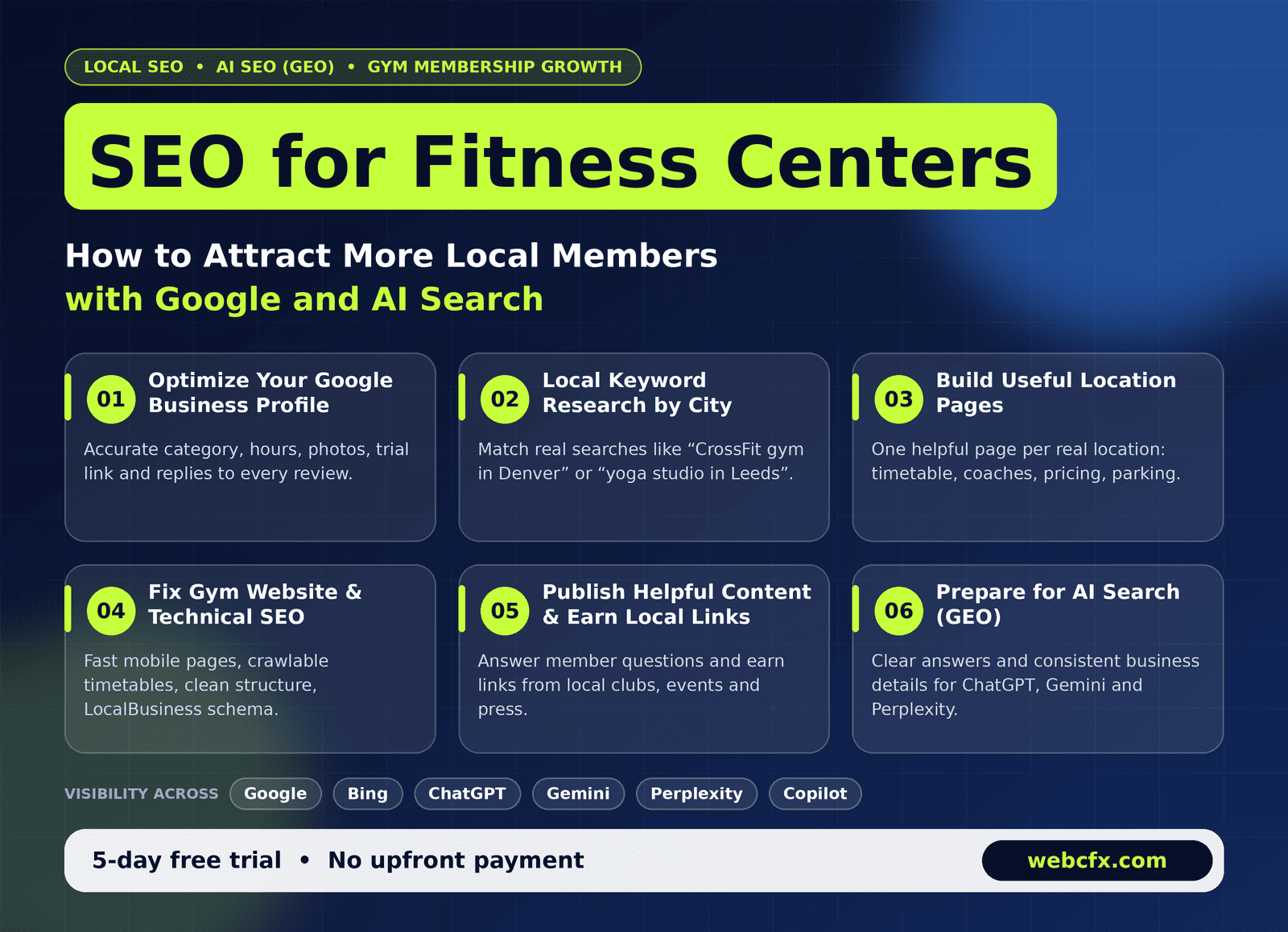
Common Challenges Fitness Centers Face in Search
Most fitness business marketing leans on social posts, promotions and word of mouth. These work, but they depend on constant effort or ad spend. Search problems are often quieter and easier to miss.
Common issues include:
- An incomplete Google Business Profile. Missing categories, old hours or few photos weaken your local presence.
- Class timetables stored as images or PDFs. Search engines and AI tools cannot read them reliably.
- One generic “Locations” page. Multi-location gyms often skip separate, useful pages for each site.
- Inconsistent business details. Different addresses or phone numbers across directories confuse both people and search engines.
- Slow or awkward mobile pages. Most visitors check pricing and timetables on a phone.
- Thin content. Pages say “state-of-the-art equipment” but never explain classes, coaches or what a first visit looks like.
- No plan for AI search. Business details are scattered, so AI tools struggle to describe the gym correctly.
Why Organic Visibility Matters for Gyms and Fitness Studios
Joining a gym is a local, considered decision. People compare distance, class types, pricing, reviews and atmosphere. Organic search puts your business in front of them while they compare. Unlike paid ads, it keeps working when a campaign pauses.
Good gym marketing strategies combine paid promotion with steady organic visibility. Organic traffic also tends to bring people who are already searching for what you offer. That is where fitness center membership growth often starts.
Different searches need different pages. The table below shows how search intent maps to content.
| Search type | Example query | Page that should answer it |
|---|---|---|
| Informational | how to start strength training as a beginner | Blog guide or class explainer |
| Commercial investigation | best CrossFit gym for beginners near me | Class page with clear details and reviews |
| Transactional | gym membership prices, free trial class | Pricing and trial sign-up page |
| Local | yoga studio in Melbourne | Location page and Google Business Profile |
How Local SEO for Fitness Centers Works
Google states that local results rely mainly on three factors: relevance, distance and prominence. Relevance is how well your profile matches the search. Distance is how far you are from the searcher. Prominence reflects how well known your business is, including reviews and web presence. You can read more in Google’s guide to improving local ranking.
You cannot change distance. You can improve the other two, and that is where a clear local plan helps.
Optimize Your Google Business Profile
Your Google Business Profile often shows up before your website. Treat it as a landing page. Focus on these basics:
- Choose the most accurate primary category, such as gym, yoga studio or personal trainer.
- Keep hours, holiday hours, phone number and address correct.
- Add real photos of the space, equipment, classes and entrance.
- Link to your trial class, membership or booking page.
- Reply to reviews politely, whether they are positive or negative.
- Follow the business name and representation guidelines. Adding keywords to your business name can risk suspension.
This is the core of Google Business Profile optimization for gyms. It also supports Google Maps optimization, since the same profile feeds the map results.
Build Location-Based Keyword Research
Good keyword research starts with the words members use, not the words owners use. Combine a service with a place, then check which terms match real classes and facilities. Examples include “CrossFit gym in Denver,” “hot yoga in Los Angeles,” “Pilates studio in Brisbane” or “personal trainer in Glasgow.”
Spelling and language vary by market. UK, Irish and Australian searchers often write “fitness centre” and “optimisation.” Mirror that spelling on pages for those markets. In Europe, searchers often use local terms such as Fitnessstudio in Berlin, salle de sport in Paris, gimnasio in Barcelona, palestra in Milan and sportschool in Amsterdam.
| Market | Example local queries (use only where you operate) |
|---|---|
| USA | gyms in Chicago, boutique fitness studio in Miami, SEO for fitness studios in Austin |
| UK | fitness centre in Manchester, personal trainer in Bristol, yoga studio in Edinburgh |
| Canada | gym in Toronto, CrossFit gym in Calgary, Pilates studio in Vancouver |
| Australia | gym in Sydney, yoga studio in Melbourne, personal trainer on the Gold Coast |
| Europe | Fitnessstudio in München, salle de sport à Paris, gimnasio en Madrid |
Do not force every city into your content. List only the places you serve. Gym SEO in each city works best when the gym genuinely has a location or service area there.
How Do You Build Location Pages That Actually Help Members?
A multi-location gym needs one useful page per location. Each page should answer what a nearby person wants to know before visiting.
A strong location page includes:
- The full address, embedded map and parking or public transit details.
- Opening hours and a crawlable class timetable in HTML text.
- Coaches and facilities that are specific to that site.
- Local membership options, trial offers and sign-up links.
- Reviews or testimonials from that location only.
- A short FAQ based on real member questions.
Avoid copying one page and swapping the city name. Google’s guidance on helpful content favors pages created for people, not for search engines. Pages with only the location name changed add little value.
Gym Website Optimization: On-Page and Technical SEO
Strong gym website optimization makes pages easy to read for members and easy to crawl for search engines.
On-page basics:
- Write unique title tags and meta descriptions for each class, trainer and location page.
- Use one clear H1 per page, with logical H2 and H3 headings.
- Create separate pages for major services, such as personal training, group classes and memberships.
- Show pricing or clear next steps, such as a free trial class.
- Add descriptive alt text to photos of your facility and classes.
Technical basics:
- Make sure the site loads quickly and works well on mobile.
- Keep class timetables and prices in HTML text, not only in images or embedded widgets.
- Check that important pages are crawlable and not blocked by robots.txt or noindex tags.
- Use a clean URL structure and an XML sitemap.
- Add LocalBusiness structured data. Schema.org also has more specific types, such as HealthClub and ExerciseGym.
Technical SEO for gym websites matters most for multi-location businesses and sites with complex booking systems. Google Search Console helps you find indexing and mobile problems.
Content Marketing and Backlinks for Fitness Businesses
Content marketing for gyms should answer real member questions. Good topics include:
- What to expect at a first class or personal training session.
- How to choose between strength training, CrossFit, yoga and Pilates.
- Beginner guides tied to your actual programs.
- Coach profiles that explain qualifications and training style.
- Neighborhood guides, such as safe running routes near your gym.
Keep health and fitness claims careful and accurate. Avoid promising specific results. Where relevant, cite reputable health sources.
Local backlink building should be earned, not bought. Realistic sources include local business associations, charity events, sports clubs, community sponsorships, nearby physiotherapy or nutrition practices, and local news coverage. Google’s spam policies warn against link schemes, so avoid buying links or swapping them in bulk.
How AI SEO (GEO) Helps Fitness Centers Appear in AI Search
What is AI SEO for fitness centers? AI SEO, or generative engine optimization (GEO), is the practice of making your business information clear, consistent and trustworthy. That helps AI search tools understand and describe your gym accurately. It builds on traditional SEO. It does not replace it.
People now ask AI tools questions such as:
- “What is the best CrossFit gym near downtown Denver for beginners?”
- “Which yoga studios in Dublin offer a free trial class?”
- “How do I find a personal trainer in Perth who works with older adults?”
AI search visibility for fitness businesses depends on several signals. These tools may include ChatGPT, Google AI Overviews, Google AI Mode, Gemini, Perplexity and Microsoft Copilot. Google states that pages must be indexed and eligible to appear in Search with a snippet to be shown in its AI features, and that no extra technical requirements apply. See Google’s guide to AI features. Strong SEO fundamentals therefore remain the foundation.
Practical steps include:
- Answer questions directly. Put the answer in the first sentence, then add detail.
- Keep business facts consistent. Name, address, phone, hours and services should match across your site, profile and directories.
- Describe services clearly. Say who each class is for, what level it suits and where it takes place.
- Earn real reviews and mentions. Honest third-party mentions help AI tools and people judge trust.
- Stay crawlable. Do not block important pages. Check indexing in both Google and Bing tools. Microsoft’s search products generally rely on Bing, so Bing Webmaster Guidelines are worth following.
- Keep content fresh. Update timetables, prices and offers when they change.
| Traditional SEO | AI SEO (GEO) | |
|---|---|---|
| Main goal | Rank pages in search results | Be understood and cited accurately in AI answers |
| Key focus | Keywords, links, technical health | Clear answers, consistent entities, trust signals |
| Success signs | Impressions, clicks, rankings | Accurate mentions, referral traffic, brand searches |
| Relationship | Foundation | Builds on the foundation |
No one can guarantee that an AI tool will recommend or cite a specific gym. The aim is to make your business easy to understand and hard to misrepresent.
Common SEO Mistakes Gyms Should Avoid
- Chasing broad keywords only. “Gym” is too broad. “Women’s strength training gym in Leeds” matches clearer intent.
- Cloning city pages. Duplicate pages with swapped place names rarely help members or rankings.
- Ignoring reviews. Unanswered reviews signal neglect to members and reduce trust.
- Hiding information in images or PDFs. Timetables and pricing should be readable text.
- Using a different phone number or address in each directory. Consistency matters for local trust.
- Stuffing keywords. Repeating “gym near me” in every sentence harms readability.
- Skipping measurement. Without tracking, you cannot tell which pages bring inquiries.
- Expecting instant results. SEO takes time, and no honest provider can promise rankings.
Building a Long-Term SEO Strategy for Your Fitness Business
A sustainable plan works in phases rather than quick fixes.
Phase 1: Audit and foundation. Review your Google Business Profile, website health, indexing, local listings and competitors. Fix technical issues and inconsistent business details first.
Phase 2: Core pages and local content. Build or improve service pages, location pages, class pages and pricing pages. Add structured data and a crawlable timetable.
Phase 3: Authority and AI readiness. Publish helpful articles, earn relevant local links, strengthen reviews and make your information clear for AI search.
Phase 4: Measure and refine. Track impressions, clicks, queries, calls, form submissions and trial sign-ups. Update pages that underperform and expand those that work.
Repeat Phase 4 regularly. Search results, AI features and competitors keep changing.
How WebCFX Can Help Fitness Businesses
WebCFX provides SEO and AI SEO (GEO) services, including local SEO, technical SEO, on-page SEO, off-page SEO and content optimization. For fitness centers, that means customized SEO services for gyms, studios and personal training businesses. The work covers keyword research, Google Business Profile support, location pages, technical fixes, helpful content and AI search readiness.
Each fitness business is different. A yoga studio, a CrossFit box and a multi-location franchise have different audiences and competitors. WebCFX builds the strategy around your services, locations and goals.
If you run a client-based business, you may also find our guide to SEO for career coaches useful. It covers similar ideas for trainers who sell expertise and one-to-one sessions. For more on local search for service businesses, see our guides on SEO for cleaning companies and SEO for roofing companies.
Frequently Asked Questions
How much does SEO cost for a gym?
Cost depends on your market, competition, number of locations and the scope of work. A single studio in a small town usually needs less than a multi-location club in a major city. Compare providers by what the plan includes. You can review WebCFX’s free trial plans to see the options.
How long does SEO take to work for a fitness center?
There is no fixed timeline, and nobody can promise one. Results depend on competition, your website’s current state and how quickly fixes are made. Local profile improvements can sometimes show earlier than broader organic gains. Expect SEO to be an ongoing effort rather than a one-time project.
Why is my gym website not ranking on Google?
Common causes include weak local signals, thin or duplicate pages, slow mobile loading, indexing problems and few trusted mentions. Check Google Search Console first for indexing and coverage issues. Then review your content, your Google Business Profile and how you compare with nearby competitors.
How can a gym appear in ChatGPT, Gemini or Perplexity answers?
No tactic guarantees it. Start with strong SEO, accurate business information and clear, helpful pages. Add consistent listings, real reviews and direct answers to member questions. Make sure your site is indexed in Google and Bing.
Do small studios need SEO, or is social media enough?
Social media helps with community and brand. SEO captures people who are actively searching for a place to train. Many studios benefit from both, with SEO supporting steady local discovery.
Is a Google Business Profile enough on its own?
It is essential, but it works best alongside a good website. Your website provides detail, trust and conversion pages that a profile cannot. Together they give search engines and AI tools more to work with.
Can one gym website rank in several cities?
Only if the business genuinely operates or serves people in those places. Create a useful page for each real location or service area. Do not create pages for cities you do not serve.
Conclusion
SEO for fitness centers is about being visible when nearby people are ready to join. Local SEO, a helpful website, honest reviews and AI-ready information all work together. Each piece supports gym membership marketing and makes your business easier to find, understand and trust.
Ready to Grow Your Business Through SEO and AI Search?
Whether you operate an online store or a service-based business, improving your organic search visibility can create more opportunities to reach potential customers.
WebCFX provides SEO and AI SEO (GEO) services to help businesses improve Google rankings, attract relevant organic traffic and build visibility across AI search platforms such as ChatGPT, Gemini and Perplexity. For fitness centers and gyms, we can build a customized strategy around your locations, classes and membership goals.
Explore Our Client Experience: https://webcfx.com/latest-clients/
You can start with our 5-day free trial with no upfront payment. You can review our actual work, including the first work report shared during the trial, before the first billing. Then choose a suitable SEO or SEO + AI SEO plan.
Choose Your Free Trial Plan: https://webcfx.com/seo-packages/
Have questions? Contact our team on WhatsApp: https://wa.me/919569951031
Visit https://webcfx.com/ to learn more about our SEO and AI SEO services.


