
Local SEO for Handyman Business: How to Get Found on Google Maps, Search and AI Answers
Local SEO for handyman business hero graphic showing a toolbox, a map pin, a “handyman near me” search bar and an AI answer bubble
Homeowners, landlords and office managers rarely browse for a handyman. They search, scan a few results and call the business that looks closest, clearest and most trustworthy. Local SEO for a handyman business is the work that puts your company in front of those people at that moment, on Google Maps, in organic results and increasingly inside AI answers.
Demand for repairs, assembly, painting and odd jobs tends to continue even when household budgets tighten. That steady demand also attracts competition, so a good website and a few reviews are rarely enough. This guide explains how handyman SEO services work, which pages and profiles matter most, and how AI SEO (also called Generative Engine Optimization, or GEO) fits alongside traditional local search. It is written for owners and managers in the USA, UK, Canada, Australia and Europe.
Common Challenges Faced by Handyman Businesses Online
Handyman companies sell many small services, often across several neighbourhoods. That creates search problems that single-trade businesses do not face.
- One “Services” page for everything. A page that lists fifteen jobs in one paragraph rarely matches any specific search.
- Weak local signals. A thin Google Business Profile, few recent reviews and inconsistent phone numbers make it harder for search engines to trust the business.
- Heavy reliance on referrals and paid leads. Word of mouth is valuable, but it is hard to scale. Lead marketplaces and ads cost money every time.
- Copy-and-paste city pages. Pages that only swap the town name add little value and can be treated as low-quality content.
- Missing proof. No job photos, no named service areas and no clear pricing guidance leave visitors unsure whether to call.
- No plan for AI search. Many handyman sites are not written in a way that lets AI tools understand exactly what the business does and where.
Why Organic and Local Search Visibility Matters for a Handyman Business
Most handyman jobs are urgent or convenient. A leaking tap, a broken door lock or a TV that needs mounting before the weekend all start with a phone search. The searcher usually wants three things: someone nearby, someone who does that exact job, and some proof that the work is done well.
Organic and local visibility gives you a lower-cost way to appear for those searches. Unlike ads, a well-built page or profile can keep working month after month. It does not guarantee leads, but it builds an asset you own.
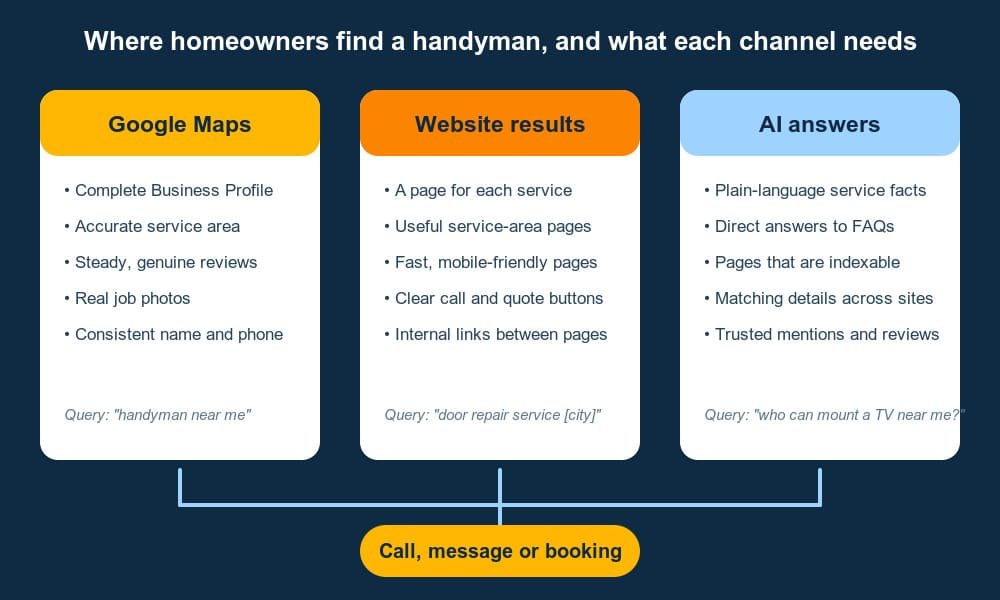
Three places homeowners find a handyman: Google Maps, website results and AI answers, all leading to a call or booking
Image alt text: “Diagram of three ways homeowners find a handyman: Google Maps, website search results and AI answers, each with the profile or page elements needed, leading to a call or booking.”
How Local SEO Helps a Handyman Business Win More Local Jobs
Local SEO helps search engines match your business to people near your service area who need your specific services. In practice, three channels matter:
- The local map pack and Google Maps. This is where “handyman near me” searches often lead.
- Organic website results. Service and area pages that answer a specific need, such as “door repair service” or “furniture assembly”.
- AI-generated answers. Tools such as Google AI Overviews, ChatGPT, Gemini, Perplexity and Microsoft Copilot summarise information and may mention or link to businesses.
These channels support each other. Accurate business details, clear service pages and genuine reviews help all three. Google’s guidance on creating helpful, reliable, people-first content is a good standard for every page you publish.
Build Handyman Service Pages That Match How People Search
The most common improvement for a handyman site is simple: give each major service its own page. Someone searching for “drywall repair” wants to see drywall repair, not a general list of everything you do.
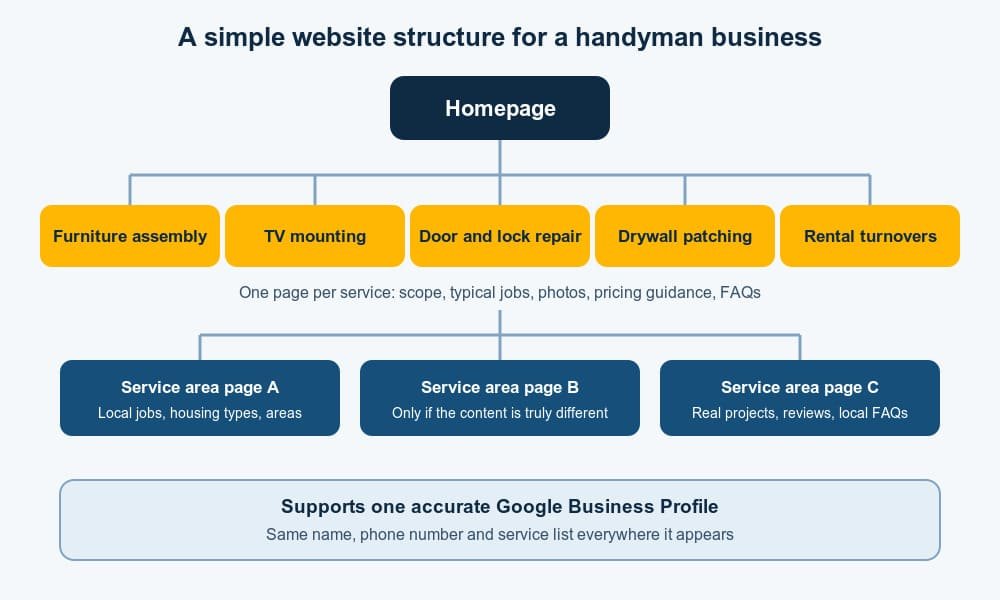
Diagram of a handyman website structure with a homepage linking to individual service pages and unique service area pages
Image alt text: “Handyman website structure diagram showing a homepage linking to service pages like furniture assembly, TV mounting, door repair, drywall patching and rental turnovers, plus unique service area pages.”
A strong service page usually includes:
- A plain description of the job and what is included
- Typical situations, such as a rental turnover or a pre-sale fix
- Real photos of your own work
- Guidance on how pricing works, such as hourly, per job or minimum call-out
- The areas you serve
- Three to five genuine questions customers ask
- A clear call or quote button
Here are examples of how service types map to search intent.
| Service page | What the searcher usually wants | Helpful page element |
|---|---|---|
| Furniture assembly | A quick, reliable helper | Typical items, time estimates |
| TV mounting | Safe installation on the right wall type | Wall types handled, cable tidy options |
| Door and lock repair | Fast fix, often urgent | Response times, emergency call details |
| Drywall and paint touch-ups | Neat finish | Before and after photos |
| Rental property maintenance | Repeat work for landlords | Contract options, turnover checklist |
| Commercial maintenance | Reliable help for offices and shops | Insurance details, out-of-hours options |
Residential and commercial work often need different pages because the buyer and the decision differ. Our guide on residential vs commercial cleaning SEO shows the same principle in another home service trade.
Optimize Your Google Business Profile as a Service-Area Business
If you travel to customers, Google treats you as a service-area business. Google’s guidelines for representing your business say service-area businesses should have one profile for the central location with a designated service area, and that a service area should generally not extend beyond about two hours of driving time from where the business is based.
Practical steps:
- Choose accurate primary and secondary categories for the work you really do.
- List the services you offer in clear language.
- Define your service area by the cities and postal codes you actually serve.
- Hide your address if customers do not visit you there.
- Keep your business name, phone number and hours identical to your website.
- Add recent photos of real jobs and answer questions that customers ask.
- Ask satisfied customers for honest reviews and reply to them professionally.
Avoid creating extra profiles for cities where you have no real base. It can cause suspensions and wastes time.
Create Location Pages Without Creating Thin Content
Many handyman businesses serve several towns, suburbs or boroughs. Location pages can help, but only when each one contains information that is genuinely different.
Useful local content might include:
- Common housing types and typical repair needs in that area
- Examples of recent jobs you completed there (with permission)
- Local reviews that mention the area
- Travel or scheduling notes for that part of your service area
- Local FAQs, such as access in apartment buildings or older properties
Location choices depend on where you actually work. For example:
- USA: a business in Texas might build a strong page for Austin, while one in Arizona might focus on Phoenix.
- UK: a handyman in the North West might create content for Manchester, while another might serve Birmingham or Leeds. Remember that UK searchers may also use words like “odd job man” or spell “optimisation” differently.
- Canada: Toronto and Calgary searchers often combine the city with the service, such as “handyman services in Toronto”.
- Australia: Brisbane and Perth are examples of metro areas where local service pages could be relevant.
- Europe: Dublin is one example of an English-language market where handyman searches are common.
Do not add a city simply because it has high search interest. Only include areas you serve and can describe honestly.
Technical and On-Page SEO Basics for Handyman Websites
Good content still needs a site that search engines can crawl and visitors can use on a phone.
- Mobile speed and usability. Many handyman searches happen on mobile, often in a hurry.
- Crawlable pages. Make sure important pages are not blocked by robots.txt or a noindex tag.
- Clear titles and headings. Use descriptive page titles that include the service and, where relevant, the area.
- Internal links. Link your service pages to each other and to relevant area pages.
- Structured data. LocalBusiness structured data can help describe your business details. Only mark up information that is visible and accurate on the page.
- Visible contact options. A click-to-call button and a short enquiry form reduce friction.
For a broader overview of how WebCFX approaches these fundamentals for service trades, see our existing article on SEO for handyman business.
How AI SEO (GEO) Can Improve Handyman Business Visibility
AI search tools answer questions in sentences instead of listing ten links. A homeowner might ask, “Who can mount a TV and fix a squeaky door near me?” Whether a tool mentions your business depends on many factors, and no one can guarantee a citation.
You can still make your business easier to understand. According to Google’s guidance on AI features and your website, the SEO best practices that already apply remain relevant for AI Overviews and AI Mode, and no extra special optimisation is required. A page must be indexed and eligible to appear with a snippet to be considered as a supporting link.
What that means for a handyman business:
- Write direct answers. Open service pages with a clear explanation of what you do, where you work and who you help.
- Use question-style headings where they match real customer questions, such as “Can you mount a TV on a plasterboard wall?”
- Keep details consistent. Use the same business name, phone number and service list on your website, Google Business Profile and other listings.
- Show real-world proof. Reviews, project photos and clear descriptions give AI systems and humans more to work with.
- Keep content crawlable. Important information should be in text, not hidden inside images or scripts.
- Earn genuine mentions. Local organisations, suppliers and community sites that legitimately reference your business help build trust.
Traditional SEO and AI SEO work together. Strong local SEO provides the foundation, and GEO adds attention to clarity, structure and the questions people ask AI assistants. Our article on AI SEO for roofing companies explains how this approach applies to another local trade.
Common SEO Mistakes Handyman Businesses Should Avoid
- Listing every service on a single page
- Publishing near-identical pages for each city
- Using a virtual office or an address where you do not operate
- Buying reviews or links, or asking staff to post fake reviews
- Letting phone numbers and business names differ across directories
- Ignoring mobile layout and page speed
- Blocking important pages by accident when a site is redesigned
- Treating SEO as a one-time project instead of an ongoing process
- Writing for algorithms instead of customers
How to Build a Long-Term Handyman SEO Strategy
SEO usually takes time to show results, and results vary by competition, location and starting point. A realistic plan focuses on steady, useful work.
| Phase | Focus | Examples |
|---|---|---|
| Month 1 | Foundations | Audit the site, fix crawl issues, claim and complete Google Business Profile, confirm NAP consistency |
| Months 2-3 | Core pages | Create or improve main service pages, add photos, FAQs and calls to action |
| Months 3-5 | Local expansion | Add genuine service-area pages, build local citations, collect reviews |
| Ongoing | Growth | Publish helpful guides, earn relevant links, review Search Console data, refine AI-friendly answers |
Track impressions, clicks, queries, average position, calls, form enquiries and booked jobs. Review the data monthly and adjust.
How WebCFX Can Help Handyman Businesses
WebCFX provides SEO and AI SEO (GEO) services for service-based businesses and ecommerce stores. For handyman businesses, that can include keyword and search intent research, service page improvements, website optimization, Google Business Profile guidance, technical SEO checks, on-page optimization, white-hat link building and content that answers real customer questions. Together, these steps support steadier online marketing and lead generation for handyman business owners who want fewer gaps between jobs.
If you want to see what our work looks like, you can explore our latest clients and work. Our focus is long-term visibility, not shortcuts.
Frequently Asked Questions
How can a handyman business get more customers from Google?
Start with an accurate Google Business Profile, separate service pages for your main jobs, genuine reviews and a fast mobile website. Add local content that reflects the areas you really serve. Results take time and cannot be guaranteed.
How much does SEO cost for a handyman business?
Costs depend on competition, the size of your service area, the number of services and how much content is needed. Ask any provider for a clear scope, monthly deliverables and reporting. You can review WebCFX plans on our SEO packages page.
Why is my handyman website not ranking on Google?
Common causes include a single services page, thin or duplicated location pages, technical crawl problems, weak local signals and few reviews. A site audit and a review of Google Search Console data can show where to start.
Do I need a separate page for every city I serve?
Only if you can provide unique, useful information for each area. For a small service area, one strong page may be better than many weak ones. Quality matters more than quantity.
Should I show my home address on my Google Business Profile?
Google’s guidelines say service-area businesses that do not serve customers at their address should hide it. Follow the current guidelines and verify your profile accurately.
How can a handyman business appear in AI search results?
Focus on clear, accurate, helpful content, consistent business details, genuine reviews and pages that search engines can crawl and index. No one can guarantee mentions in ChatGPT, Gemini, Perplexity, Copilot or Google AI Overviews.
How long does handyman SEO take to work?
Many businesses need several months of consistent work before seeing meaningful change, but timing depends on competition, site quality and local demand.
Conclusion: Start with Clear Pages and Accurate Local Signals
Local SEO for a handyman business is not about tricks. It is about making it easy for a nearby customer to see what you do, trust the evidence and contact you. Clear service pages, a well-managed Google Business Profile, useful local content and AI-friendly answers all support that goal.
Ready to Grow Your Handyman Business Through SEO and AI Search?
Whether you run a one-person handyman service or manage a team, improving your organic search visibility can create more opportunities to reach potential customers.
WebCFX provides SEO and AI SEO (GEO) services to help businesses improve Google rankings, attract relevant organic traffic and build visibility across AI search platforms such as ChatGPT, Gemini and Perplexity. No one can promise rankings or AI citations, but you can judge the quality of the work for yourself.
Explore Our Client Experience: https://webcfx.com/latest-clients/
You can start with our 5-day free trial with no upfront payment and review our actual work before deciding on a long-term service. The first work report is shared during the trial period, and you can choose a suitable SEO or SEO + AI SEO plan afterwards.
Choose Your Free Trial Plan: https://webcfx.com/seo-packages/
Have questions? Contact our team on WhatsApp: https://wa.me/919569951031
Visit https://webcfx.com/ to learn more about our SEO and AI SEO services.


