
SEO for Life Coaches: How to Get Found by Clients on Google and in AI Search
SEO for life coaches means making your website easy for search engines and AI assistants to find, understand and recommend when someone searches for help with a life change. Most people do not type “life coach.” They type “how do I stop feeling burned out” or “coach for career change near me.”
That gap is the main SEO challenge for this industry. Coaching is a trust-based, high-consideration service. Prospects read, compare and wait before they book a discovery call.
This guide explains how life coaches in the USA, UK, Canada, Australia and Europe can build visibility through SEO services, local search and AI SEO (GEO). It also shows how professional SEO support from WebCFX fits into the plan.
Why Is It Hard for Life Coaches to Get Clients From Google?
Life coaching is broad, crowded and rarely searched by exact job title. A visitor with a specific problem must land on a page that speaks to that problem. Generic homepages rarely do.
Common challenges include:
- One “services” page for everything. Burnout, divorce recovery, confidence and career change all share a single page, so none ranks well.
- Heavy reliance on referrals and social media. Both are useful, but neither compounds like search content does.
- Thin or copied bio text. Pages that say “I help you unlock your potential” give search engines and AI tools nothing specific to match.
- No clear location or format. Visitors cannot tell if you coach online, in person, or both.
- Weak trust signals. Missing credentials, no client-approved reviews, no clear coaching approach.
- Technical gaps. Slow pages, poor mobile layout, or pages that are not indexed.
Why Does Organic Search Visibility Matter for Life Coaches?
Organic visibility puts your expertise in front of people who are already looking for help. Unlike paid ads, a well-built page can keep attracting relevant visitors without a per-click cost.
It also builds trust. A prospect who finds a clear article about burnout recovery, then reads your coaching approach, arrives at your discovery call page better informed. These are often stronger enquiries than a cold social media message.
Search is also changing. Google now shows AI Overviews and AI Mode in many searches, and people use ChatGPT, Gemini, Perplexity and Microsoft Copilot to ask for coach recommendations. We cover this in the AI SEO section below.
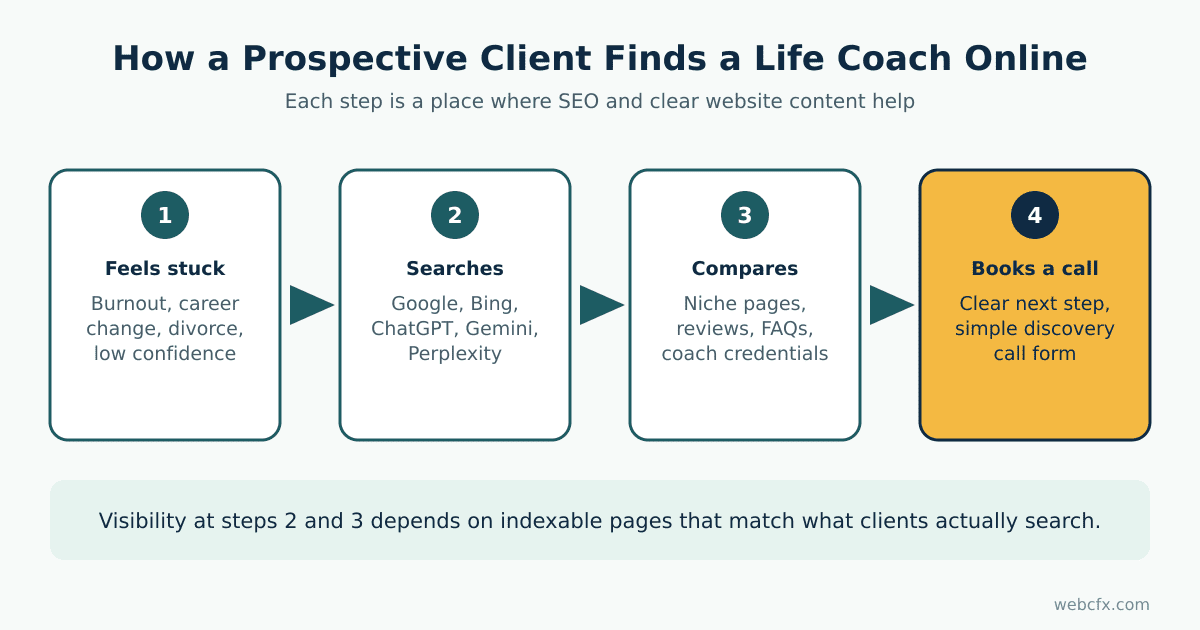
Four-step diagram showing how a prospective client moves from feeling stuck, to searching, to comparing coaches, to booking a call
How Does SEO Help Life Coaches Attract More Clients?
SEO helps by matching your pages to the questions prospective clients actually ask. A strong coaching website answers those questions, shows your credentials and makes the next step simple.
In practice, SEO for coaches works across four areas:
- Keyword research and search intent. Understanding whether a searcher wants information, a comparison or a booking.
- Page structure. One focused page per coaching niche, not one page for everything.
- Technical health. Fast, mobile-friendly, crawlable pages that search engines can index.
- Authority. Helpful content, genuine reviews and relevant, white-hat mentions from trusted sites.
No provider can guarantee rankings, traffic or enquiries. Search results depend on competition, content quality and search engine changes. What SEO does is remove avoidable obstacles and improve your chances.
What Do Prospective Clients Search For?
Searches usually fall into three intent groups. Your website should have a page type for each.
| Search intent | Example searches | Best page type |
|---|---|---|
| Informational | “why do I feel stuck in my career,” “how to rebuild confidence after divorce” | Helpful blog articles and guides |
| Commercial | “burnout coach online,” “life coaching packages,” “what to expect from a life coach” | Niche service pages, FAQ and process pages |
| Transactional / local | “life coach near me,” “book a discovery call,” “life coach in Toronto” | Contact page, booking page, Google Business Profile, location-aware pages |
Which SEO Strategies Work Best for Life Coaches?
The best SEO strategy for life coaches is to choose a clear niche, build focused pages for each, and support them with helpful content and a technically healthy site. Google’s own guidance says its ranking systems prioritise helpful, reliable content created to benefit people rather than to manipulate rankings, per Google Search Central’s helpful content guidance.
Build Niche Service Pages
Create one page for each main coaching specialty. Examples include a burnout coach page, a career change coach page, a confidence coach page or a life transition coaching page. Each should cover who it is for, the problem, your coaching approach, session format, typical outcomes you can honestly describe and a clear call to action.
If you coach career transitions specifically, see our guide to SEO for career coaches. That article focuses on career-specific search behaviour. This one covers the wider life coaching niche.
Write Problem-Led Content
Publish articles that answer real questions in plain language. Use the words clients use, not coaching jargon. Add your experience, your method and practical steps. Original perspective is what separates your content from generic wellbeing articles.
Show Credentials and Be Careful With Claims
State your training, certifications (for example, accreditation from a coaching body, if you hold one), years of practice and the kinds of clients you serve. Coaching is not therapy. Avoid medical or mental health claims, and explain when a client may be better served by a licensed professional. This protects clients and builds credibility.
Make Technical SEO Simple and Reliable
Check that pages load quickly on mobile, use clear headings, have unique title tags and meta descriptions, and are not blocked from crawling. Google notes that pages must be indexed to appear as supporting links in AI features, and that standard SEO fundamentals still apply, in its guidance on AI features and your website.
Use Internal Links Between Related Pages
Link your niche pages, articles and contact page together. Internal links help visitors move toward a booking and help search engines discover your content. Google also lists findability through internal links among the basics for AI features.
How Can Life Coaches Use Local SEO to Attract Local Clients?
Local SEO helps in-person and hybrid coaches appear for searches like “life coach near me” or “life coach in Manchester.” Online-only coaches can still use location-aware content, but their eligibility for map listings is different.
Key steps:
- Check Google Business Profile eligibility. Google’s guidelines say a business should make in-person contact with customers during stated hours, and a home-based business should not display its residential address. Read the Google Business Profile guidelines before creating a listing.
- Keep business information consistent. Use the same name, phone number and service details on your website, your profile and any directories.
- Build useful location pages only where you genuinely serve clients. A page for each city with only the city name swapped is thin content. Add real local detail, such as in-person session options, regional client concerns or local venues you work from.
- Encourage genuine reviews. Ask satisfied clients to share honest feedback. Never write or buy reviews.
Where Do Location-Based Searches Come From?
Prospective clients in different markets may search for phrases such as “life coach in New York” or “life coach in Austin” in the USA, “life coach in London” or “life coach in Manchester” in the UK, “life coach in Toronto” or “life coach in Vancouver” in Canada, and “life coach in Sydney” or “life coach in Melbourne” in Australia. In Europe, cities such as Dublin, Amsterdam and Berlin may matter, often with local-language variants.
Use only the locations you actually serve. At state and regional level, you might reference California, Texas, Ontario, British Columbia, New South Wales or Victoria where relevant. Remember spelling differences: “optimization” and “center” in the US, “optimisation” and “centre” in the UK, Canada and Australia.
How Can Life Coaches Appear in AI Search Results?
Life coaches can improve their chances of appearing in AI answers by publishing clear, accurate, well-structured information and keeping their pages crawlable and indexed. Nobody can guarantee that ChatGPT, Gemini, Perplexity, Google AI Overviews or Microsoft Copilot will recommend a particular coach.
Google states there are no additional requirements to appear in AI Overviews or AI Mode, and that existing SEO best practices remain relevant. AI features in Google Search are also included in overall Search Console traffic. See Google’s AI features documentation.
What Is AI SEO (GEO) for Life Coaches?
AI SEO, also called generative engine optimization (GEO), is the practice of presenting your expertise so AI tools can understand it. For life coaches, that usually means:
- Direct answers. Start sections with a short, clear answer, then add detail.
- Question-based headings. “How does burnout coaching work?” matches how people ask AI assistants.
- Specific, consistent entity information. Who you are, who you help, where and how you coach, and your credentials.
- Structured, scannable pages. Short paragraphs, lists, tables and FAQs.
- Crawlable and indexed pages. If a page is not indexed, it cannot be shown.
- Bing visibility. Copilot is connected to Microsoft’s search ecosystem, so Bing Webmaster Tools and sitemap hygiene are worth setting up.
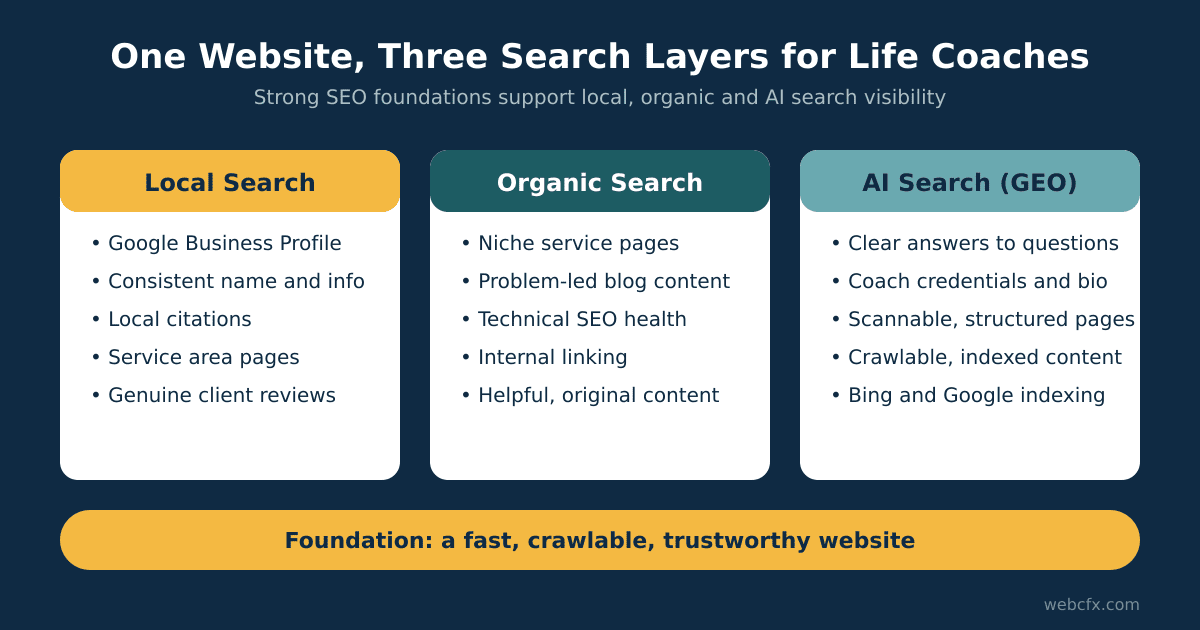
Diagram showing local search, organic search and AI search as three layers built on one technically healthy website
How Do SEO and AI SEO Work Together?
Traditional SEO builds the foundation: indexable pages, clear intent, authority and local signals. AI SEO builds on it by making answers explicit and information consistent. A coach with a weak website will struggle in both. A coach with a strong, well-organised website is better positioned for both.
What Are the Most Common SEO Mistakes Life Coaches Make?
- Targeting only “life coach.” It is competitive and vague. Niche, problem-based and format-based phrases are usually clearer.
- Writing for algorithms. Keyword-stuffed pages read poorly and conflict with Google’s people-first guidance.
- Creating duplicate city pages. Swapping the city name does not create value.
- Hiding the offer. No pricing guidance, no process, no clear next step.
- Ignoring indexing. Publishing without checking Google Search Console or Bing Webmaster Tools.
- Making unsupported promises. Guaranteed life transformation claims reduce trust.
- Forgetting the booking path. Great traffic does not help if the discovery call form is hard to find.
How Do You Build a Long-Term SEO Strategy as a Life Coach?
Build in stages and measure each one.
- Month 1: Foundation. Audit technical health, define your niche, map keywords to pages and fix indexing issues.
- Months 2–3: Core pages. Publish or improve niche service pages, About, FAQ and booking pages.
- Months 3–6: Content and local. Add problem-led articles, set up or tidy your business profile if eligible, and build natural citations.
- Ongoing: Authority and review. Earn relevant mentions, update older pages and review search queries, clicks and enquiries.
These phases are a planning guide, not a promise of timing. Results vary by market, competition and content quality.
How Can WebCFX Help Life Coaches?
WebCFX provides SEO and AI SEO (GEO) services for ecommerce stores and service-based businesses, including coaches. The work typically covers keyword and intent research, on-page optimisation, technical SEO, local SEO, content optimisation and AI search readiness.
If you want to see the kind of SEO work we do, explore our latest clients and work. Our team can also review whether your current website is set up for niche pages, local search and AI visibility. You can read more about our approach on the WebCFX website.
For related reading, see how AI search affects coaches in AI SEO for career coaches, or how another wellbeing-focused service business approaches visibility in SEO for yoga instructors.
Frequently Asked Questions
How can life coaches get more clients from Google?
Create focused pages for each coaching niche, answer common client questions in helpful articles, keep your website fast and indexable, and make your discovery call easy to book. Local profiles and genuine reviews can support this if you offer in-person coaching.
How much does SEO cost for life coaches?
Costs depend on your niche, competition, website condition and the scope of work, so there is no single figure. Ask any provider what is included, how work is reported and whether contracts are flexible. WebCFX offers a free trial, described below.
What is the best SEO strategy for life coaches?
Choose a clear niche, build one strong page per service, publish problem-led content, keep technical SEO healthy and track search queries and enquiries. Add local SEO if you serve a specific area.
Can online life coaches use local SEO?
Yes, to a degree. Google Business Profile has eligibility rules tied to in-person contact, so many online-only coaches may not qualify. You can still create honest location-aware content, such as the time zones or regions you serve, without implying a physical office.
Why is my life coaching website not ranking on Google?
Common causes include pages that are not indexed, thin or generic content, no clear niche, weak internal links and strong competition. Check Google Search Console for indexing and query data first.
How can a life coach appear in AI search results?
Publish clear, accurate answers, show credentials, keep information consistent across your website and profiles, and make sure pages are indexed in Google and Bing. No one can guarantee AI citations.
Do life coaches need a blog?
A blog is not mandatory, but helpful articles are one of the main ways to reach people who are not yet searching for a coach by name. Quality and relevance matter more than volume.
Ready to Grow Your Coaching Practice Through SEO and AI Search?
Whether you coach in person, online or both, better organic visibility can create more opportunities to reach people who need your help. SEO for life coaches works best when it is built on a clear niche, helpful content and a technically healthy website.
WebCFX provides SEO and AI SEO (GEO) services to help businesses improve Google visibility, attract relevant organic traffic and build presence across AI search platforms such as ChatGPT, Gemini and Perplexity. We do not guarantee rankings, traffic or enquiries, but we do show you the work.
Explore our client experience: https://webcfx.com/latest-clients/
You can start with our 5-day free trial with no upfront payment. During the trial you can review the SEO work being completed and see the first work report. You can evaluate the work before the first billing, then choose a suitable SEO or SEO + AI SEO plan.
Choose your free trial plan: https://webcfx.com/seo-packages/
Have questions? Contact our team on WhatsApp: https://wa.me/919569951031
Visit https://webcfx.com/ to learn more about our SEO and AI SEO services.


