
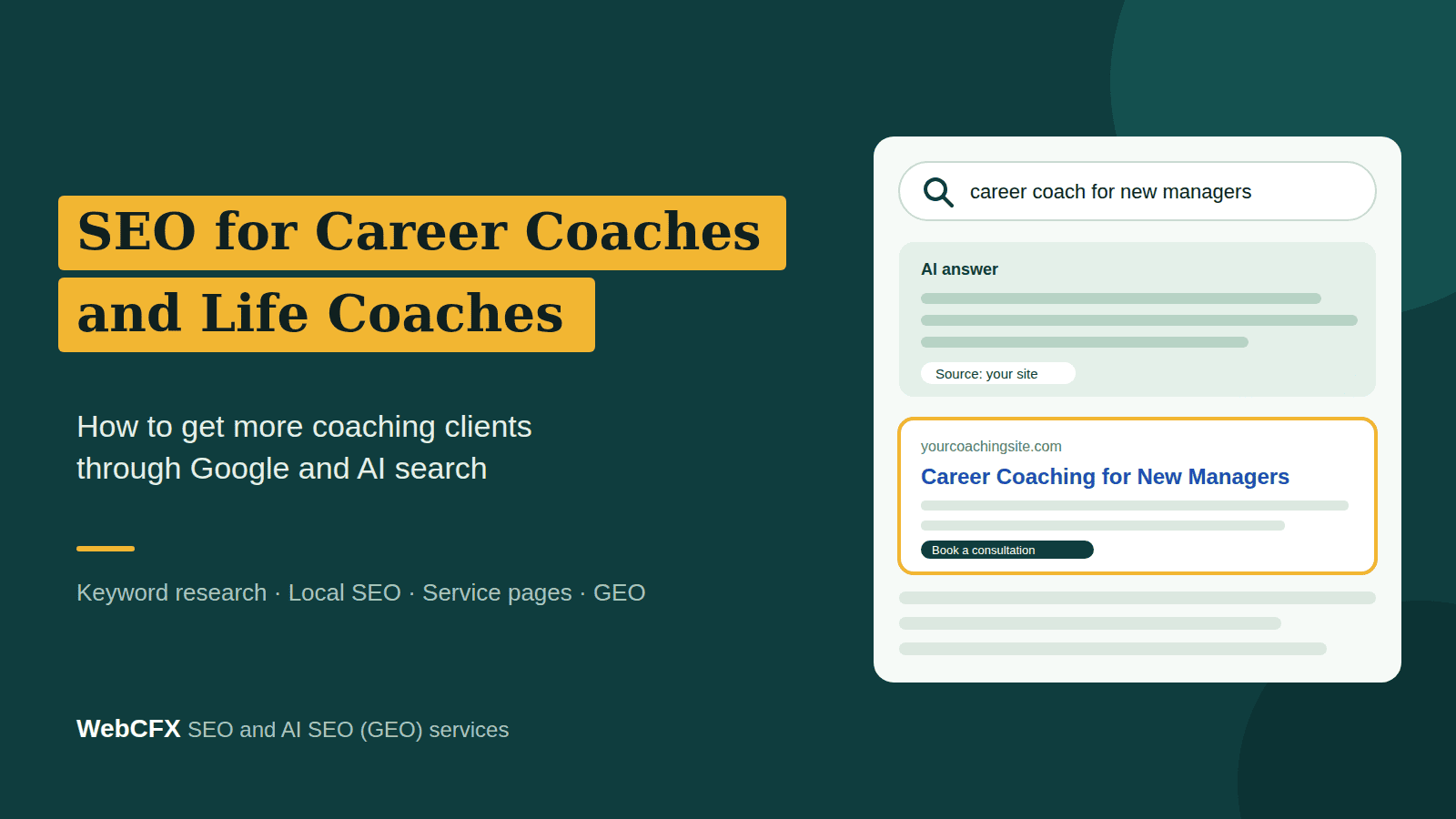
SEO for Career Coaches and Life Coaches: How to Get More Coaching Clients Through Google and AI Search
SEO for career coaches is the work of making your coaching website easy for Google, Bing and AI search tools to find, understand and recommend. When someone searches “career coach for mid-level managers” or “life coach for burnout,” they are close to a decision. If your site doesn’t appear, a competitor gets that consultation request.
Most coaches rely on referrals, social media and paid ads. Those channels work, but they stop when you stop. Organic search builds slowly and keeps working once your pages are in place.
This guide covers how to attract qualified coaching clients through Google and AI search. That includes keyword research, service pages, local SEO, technical health and AI SEO (also called Generative Engine Optimization, or GEO).
Common Challenges Faced by Career Coaches and Life Coaches
Many coaching websites look polished but bring in few enquiries. The usual causes are practical, not mysterious.
- One generic “Services” page. Career transitions, executive coaching and burnout recovery are different searches. One page can’t serve all of them.
- Vague language. Phrases like “unlock your potential” rarely match what people type into a search box.
- Weak local signals. Coaches who meet clients in person often have an incomplete Google Business Profile and inconsistent business details.
- Thin content. A blog with a few motivational posts doesn’t build authority on any one topic.
- Heavy reliance on referrals and ads. Visibility stops the moment the budget or the network dries up.
- Little structure for AI tools. Credentials, methods and pricing details are buried in images or long paragraphs.
Why Organic Search Visibility Matters for Coaching Businesses
Coaching is a trust purchase. Prospects research before they book, and they often compare several coaches over days or weeks. Organic search puts your expertise in front of them during that research.
Clicks from organic results also tend to come from people actively looking for help. They have a problem and are searching for a solution. That is a different mindset from someone scrolling past an ad.
Search is also changing. Google now shows AI Overviews and AI Mode in some searches. People also ask ChatGPT, Gemini, Perplexity and Microsoft Copilot for coach recommendations and comparisons. A coaching business that is clearly described across the web has more chances to be understood and mentioned. Nobody can guarantee a mention.
How SEO Helps Coaches Attract Qualified Clients
Different searches signal different stages of readiness. Matching your pages to these stages is the heart of coaching website SEO.
| Search type | Example query | Best page type |
|---|---|---|
| Informational | how to change careers at 40 | Blog article or guide |
| Commercial | career coach vs life coach | Comparison or “how to choose” page |
| Transactional | book executive coaching consultation | Service page with booking link |
| Local | life coach in Manchester | Location-aware service or contact page |
A coach who covers all four stages builds a path from first search to consultation. SEO also pre-qualifies visitors. A clear page about who you serve and what you charge attracts better-fit enquiries and fewer mismatched ones.
Important SEO Strategies for Career Coaches and Life Coaches
Start With Keyword Research Based on Client Problems
Begin with the problems clients describe in discovery calls. Then check how they phrase them online.
Useful keyword groups include:
- Service keywords: career coaching for women returners, executive coaching for new managers
- Problem keywords: feeling stuck in my career, how to prepare for a promotion
- Audience keywords: coach for engineers moving into leadership
- Modifier keywords: online, virtual, in person, affordable, certified
Target low- and medium-competition long-tail phrases first. Use Google Search Console, Google’s autocomplete and “People also ask” for ideas. Treat third-party volume numbers as rough estimates.
Build One Strong Page Per Core Service
Each major service deserves its own page. A good coaching service page includes:
- A clear headline naming the service and the client it serves.
- The problem, the coaching process and what a session looks like.
- Your credentials, training and experience, stated factually.
- Format details such as online, in person, session length and packages.
- A visible consultation booking button.
- Answers to common objections, such as time commitment and confidentiality.
Use a descriptive title tag and a single H1. Write for the client first and the search engine second.
Use Local SEO Where It Genuinely Applies
Local SEO for life coaches and career coaches depends on how you work. Google’s rules matter here. According to Google, a business must make in-person contact with customers during its stated hours to qualify for a Business Profile, and online-only businesses are listed as ineligible. If you coach purely online, you probably can’t create a profile. Don’t use a virtual office to work around this, because it risks suspension. google
If you rent an office, see clients in person or travel to them, a profile may be possible. In that case:
- Keep your business name, address and phone number identical everywhere.
- Choose accurate categories and describe your services honestly.
- Collect real reviews and respond to them.
- Link the profile to the most relevant page on your site.
Google says local results are based primarily on relevance, distance, and prominence. Reviews, directories and links all feed prominence. google
Create Location Content That Is Actually Useful
Coaches serving several cities are tempted to publish a page for every location with only the city name swapped. Avoid that. Thin, near-duplicate pages add little value.
Create a location page only when you genuinely serve that area. Then add real local substance, such as:
- Where you meet clients and how to reach you.
- Industries and career issues common in that region.
- Local professional communities or events you take part in.
- Reviews or outcomes you can share with permission.
A London-based executive coach and a Toronto-based career transition coach should not have interchangeable pages. Online coaches serving a country can focus on audience and niche instead of city names.
Publish Content That Builds Topical Authority
Topical authority means covering one subject area thoroughly. A career coach might build a cluster around career transitions: a main guide, supporting articles on resumes, interviews, salary conversations and returning after a break, and a service page that ties them together.
Aim for depth in a few areas rather than scattered posts. Include your own frameworks, anonymised client scenarios (never invented) and practical exercises. Google’s guidance on helpful content favours original, people-first material, so write from experience. google
Connect Pages With Internal Links
Link related articles to your service pages using natural anchor text. A post on “how to negotiate a promotion” should link to your executive coaching page. Clear internal links help visitors move toward booking and help search engines understand which pages matter most.
Fix Technical SEO Basics
Technical SEO is the foundation under everything else. Check these areas:
- Indexing: Important pages should be crawlable and free of accidental noindex tags.
- Speed and mobile use: Test with Google PageSpeed Insights. Many prospects browse on phones.
- Site structure: Use short, readable URLs and a logical menu.
- Booking flow: Make sure scheduling widgets load reliably and don’t hide key content.
- Structured data: Add schema markup that matches your real business and visible content.
- Security: Use HTTPS.
Google Search Console shows indexing problems and the queries that bring visitors.
Earn Relevant, White-Hat Links
Links from respected sources support your authority. Realistic opportunities for coaches include:
- Guest articles or interviews on professional development publications.
- Professional association and certification body directories.
- Local business or chamber of commerce listings, where relevant.
- Podcasts and speaking events that publish show notes with links.
- Original resources others want to cite, such as a career-change checklist.
Skip paid link schemes and bulk directories. They carry real risk.
How AI SEO (GEO) Can Improve Coaching Visibility
AI SEO, or Generative Engine Optimization, focuses on being understood and cited by AI search tools. It builds on traditional SEO rather than replacing it. Google states that there are no additional requirements to appear in AI Overviews or AI Mode, nor other special optimizations necessary. For Google, strong fundamentals are the main route. google
The same fundamentals help other AI tools. Practical steps include:
- Answer questions directly. Open sections with a clear answer, then add detail.
- State facts plainly. Include your niche, location or service area, credentials, methods and session formats in readable text.
- Use consistent naming. Use the same business name, descriptions and profile details across your site, directories and social profiles.
- Support claims. Link to credible sources and show real experience.
- Keep pages crawlable. Google notes that crawling should be allowed in robots.txt and by any CDN or hosting infrastructure, and that content should be easy to find through internal links. google
- Review how AI tools describe you. Ask ChatGPT, Gemini and Perplexity about your niche and note what they say and which sources they use.
No agency can promise citations in AI answers. The goal is to be a clear, trustworthy source that these systems can use.
Common SEO Mistakes Coaches Should Avoid
- Targeting very broad terms like “life coach” instead of specific niches.
- Copying templates or competitor wording.
- Creating dozens of near-identical city pages.
- Burying the booking link or asking for too much on the form.
- Using a virtual address to qualify for a Business Profile.
- Ignoring reviews, or posting fake ones.
- Publishing AI-generated posts with no personal expertise.
- Skipping Search Console and never checking what works.
- Expecting results in a few weeks.
How to Build a Long-Term SEO Strategy for a Coaching Business
SEO compounds over time. A simple roadmap keeps the work focused.
| Phase | Focus |
|---|---|
| Months 1–2 | Audit, keyword research, technical fixes, service page rewrites |
| Months 3–4 | Local setup (if eligible), first content cluster, internal linking |
| Months 5–8 | More supporting content, link outreach, review collection |
| Ongoing | Search Console review, content updates, AI visibility checks |
Timelines vary by competition, site history and niche, so treat these phases as a planning guide, not a promise. Measure what matters to a coaching business: impressions, clicks, ranking queries, consultation form submissions and booked calls.
How WebCFX Can Help Career and Life Coaches
WebCFX provides SEO and AI SEO (GEO) services for businesses that want to improve organic search visibility. For coaching businesses, that can include keyword research, service page optimization, technical SEO review, content planning, local SEO where it applies, and structure that helps AI search tools understand your practice.
You can review the type of work we do on our latest clients page. If you want to compare options, see our SEO pricing page. Coaches who also sell courses or digital products may find our guide on SEO for beauty ecommerce stores useful for the online-store side of product SEO.
Frequently Asked Questions
Do career coaches really need SEO?
Not every coach needs it, but it helps if you want a steady flow of enquiries beyond referrals. People search for career help when they are ready to act, so organic visibility puts you in front of them at that moment.
How long does SEO take for a coaching website?
It varies. Competition, your site’s age and your niche all affect speed. Many businesses see early movement in impressions first, with enquiries following later. Anyone promising fixed timelines or rankings should be treated with caution.
Can an online-only coach use local SEO?
Only partly. Google says online-only businesses aren’t eligible for a Business Profile. You can still target regional audiences through content, directories and clear service-area information on your site.
What is the difference between SEO and GEO?
SEO helps pages rank in search results. GEO focuses on being understood and cited in AI-generated answers. Both rely on clear, trustworthy, well-structured content.
Should I hire an SEO agency or do it myself?
You can handle basics like Business Profile details and service page copy yourself. Many coaches hire help for technical audits, ongoing content and link building, because those take consistent time and expertise.
Conclusion
Coaches win clients through trust, and search is where that trust often begins. Start with clear service pages, honest local signals, helpful content and a technically sound site. Then add AI search readiness on top.
Ready to Grow Your Coaching Business Through SEO and AI Search?
Whether you coach individuals, executives or teams, better organic visibility can create more chances to reach people looking for your help.
WebCFX provides SEO and AI SEO (GEO) services to help businesses improve Google rankings, attract relevant organic traffic and build visibility across AI search platforms such as ChatGPT, Gemini and Perplexity. We don’t guarantee rankings, traffic, leads or AI citations, but we do show you the work.
- Explore our client experience: https://webcfx.com/latest-clients/
- Start with our 5-day free trial. There is no upfront payment. You can review the first work report during the trial and evaluate the work before your first billing. Choose Your Free Trial Plan: https://webcfx.com/seo-packages/
- Questions? Message our team on WhatsApp: https://wa.me/919569951031
Visit https://webcfx.com/ to learn more about our SEO and AI SEO services.


