
SEO for Commercial Pest Control Companies: How to Win Restaurant, Property and Facility Contracts
SEO for commercial pest control companies means making your business easy to find when facility decision-makers search for ongoing pest management. These buyers are not homeowners with a wasp nest. A restaurant owner, hotel manager or warehouse supervisor wants a documented programme, fast response and audit-ready reports. They compare providers carefully and often ask colleagues or AI assistants before they call.
This guide explains how commercial pest control SEO services work and how to build pages for each industry you serve. It also covers local search, technical health and AI search (GEO). The focus is on winning recurring service contracts, not one-off callouts. For a broader view that includes homeowners, read our guide to SEO for pest control companies.
How Do Commercial Pest Control Buyers Search Online?
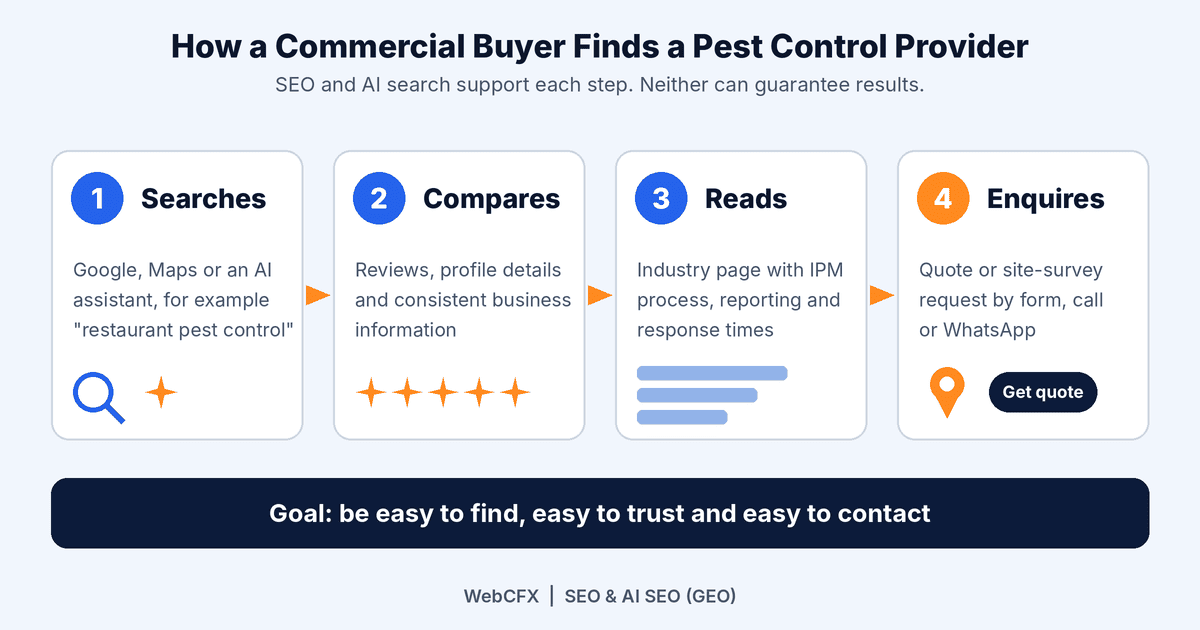
Commercial buyers search by industry, risk and urgency. They often name their sector and a specific pest. They also look for proof of process, such as monitoring, reporting and compliance support.
| Buyer | Typical search | Best page |
|---|---|---|
| Restaurant owner | restaurant pest control, cockroach control for restaurants | Restaurant page |
| Hotel manager | bed bug treatment for hotels | Hospitality page |
| Warehouse manager | warehouse pest control, commercial rodent control | Warehousing page |
| Property manager | pest control for property managers, multi-unit property pest control | Property page |
| Food producer | food facility pest management | Food industry page |
| Facility buyer | commercial pest control service contracts | Service programme page |
| Urgent buyer | commercial pest control near me | Maps listing and location page |
These are illustrative search patterns, not verified search volumes. Check real demand in Google Search Console and a keyword tool before you commit to a page.
Common Challenges Commercial Pest Control Companies Face Online
Many commercial pest management companies have strong referrals but weak online visibility. Common problems include:
- A single “Commercial” page that covers every industry
- No separate pages for restaurants, hotels, warehouses or food plants
- Generic content that never explains the inspection, monitoring and reporting process
- Weak Google Maps visibility for urgent “near me” searches
- Thin location pages with only the city name changed
- Few contact paths built for businesses, such as quote requests and site-survey forms
- Competitors, including national providers and directories, taking the top positions
- No presence in AI-generated answers
Why Does Organic Visibility Matter for B2B Pest Management?
Commercial contracts are recurring and valuable, so each new client matters more than a single job. Buyers also research before they contact anyone. They read service pages, check reviews and compare providers. Organic search puts your business in front of them during that research.
Strong organic visibility also reduces dependence on lead marketplaces and paid clicks. That makes lead generation for pest control companies more stable over time. It does not make it guaranteed.
How Does SEO Help Commercial Pest Control Companies Win Contracts?
SEO helps by matching your website, map listing and content to what facility buyers actually search for. It brings relevant visitors to pages that answer their risk, compliance and service questions. Digital marketing for commercial pest control then turns those visits into quote requests.
Good SEO does three jobs:
- It makes each industry page visible for its own searches.
- It builds trust through clear process, reporting and local proof.
- It makes enquiries easy, with a short form, a phone number and a survey request.
No provider can promise rankings or lead numbers. Results depend on your market, competition and website.
Build Industry Pages, Not One Generic Commercial Page
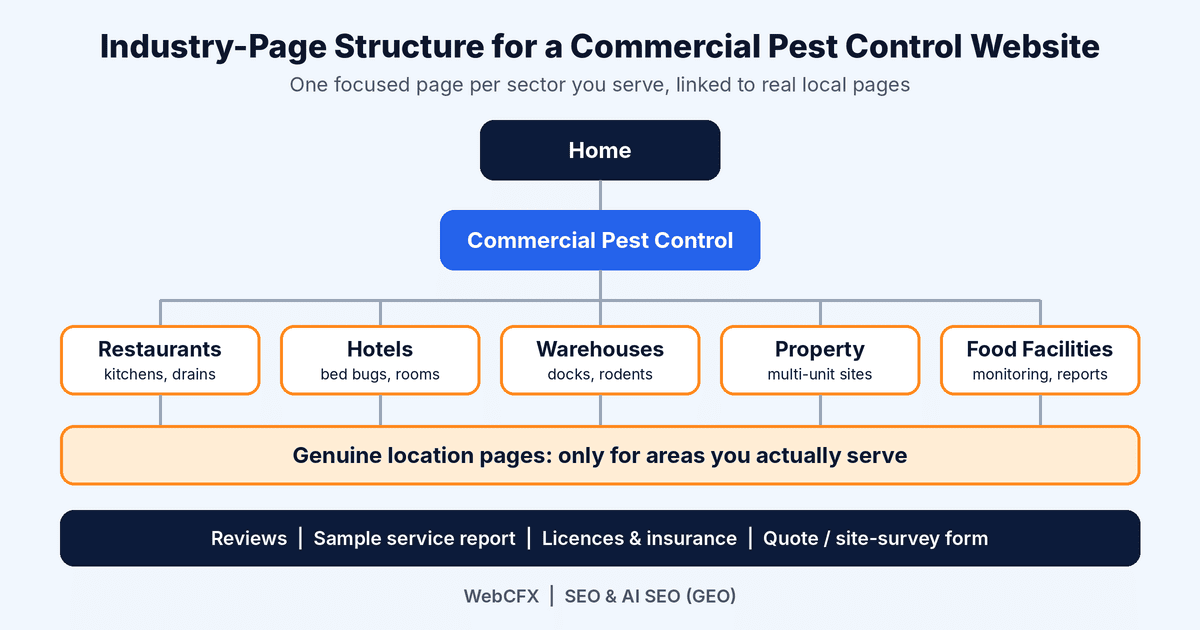
A single commercial page cannot rank well for every sector. Website optimization for pest control companies should start with one useful page per industry you genuinely serve.
A strong industry page explains:
- The pests that matter most in that sector
- How inspection, monitoring and treatment work at a customer-friendly level
- How reporting and documentation are handled
- Response times and who the site contact is
- Licensing and insurance details that apply in your region
- A clear quote or site-survey call to action
For example, a restaurant pest control page should speak to kitchens, drains, storage areas and deliveries. A warehouse pest control page should focus on dock doors, packaging and rodent entry points. Never copy one page and change the sector name.
Explain Your IPM Programmes in Plain Language
Integrated pest management (IPM) is a prevention-first approach. It combines inspection, monitoring, sanitation advice, exclusion and targeted treatment. The EPA’s guide to integrated pest management in buildings describes IPM as an environmentally friendly, common-sense approach to controlling pests.
If you offer IPM programmes, say so clearly and explain your process. Buyers searching for IPM pest control for commercial buildings want to see how it works, not just a keyword.
Show the Proof Buyers Look For
Commercial buyers want evidence before they sign. Useful trust signals include:
- A sample service report with client details removed
- A description of your monitoring and documentation process
- Real licences, insurance and memberships, stated accurately
- Genuine reviews from commercial clients, where permitted
- Clear contract terms and response expectations
Never invent certifications, client names or results. Only publish what is true and current.
Local SEO for Commercial Pest Control Companies
Local SEO for commercial pest control starts with your Google Business Profile. Local results generally depend on relevance, distance and prominence. You influence all three through your profile, website and reputation.
Focus on these basics:
- Choose an accurate primary category and relevant secondary categories
- List commercial services separately from residential ones
- Set a service area that reflects where you genuinely work
- Keep your name, address and phone number consistent across directories
- Respond to reviews professionally and never buy them
Google Maps optimization for pest control matters most for urgent searches. A facility manager with a rodent sighting may search “commercial pest control near me” and call the first credible result.
Targeting Several Cities Without Thin Pages
Location pages work when each one adds real value. Include the districts you cover, local building types and pest pressures, typical response information and relevant reviews. Competition differs by market. A company in Houston, Texas faces different rivals than one in Manchester, Greater Toronto or Sydney. Licensing rules, language and directories also vary by country.
Create pages only for areas you serve. Five strong pages beat fifty duplicates. Do not imply you have an office in a city unless it is true.
Technical SEO for Commercial Pest Control Websites
Technical SEO helps search engines crawl, understand and index your pages. A technical audit should check:
- Indexing: industry and location pages are indexable and in the XML sitemap
- Site structure: a logical path such as Home → Commercial → Industry → Location
- Speed and mobile use: fast pages and tap-to-call buttons
- Security: HTTPS across the site
- Structured data: accurate business details marked up for search engines
Google explains how to mark up business details in its LocalBusiness structured data guide. Test your markup before you ask Google to recrawl.
Off-Page SEO: Earn Relevant Backlinks
Pest control backlink building works best when it is relevant and local. Good sources include:
- Local chambers of commerce and business associations
- Trade bodies and supplier pages
- Property management and hospitality networks
- Local news coverage and community sponsorships
- Helpful guides that facility teams want to cite
Avoid paid link schemes and link farms. A few relevant links are worth more than many weak ones. The same B2B logic applies in other service categories, as our guide to residential vs commercial cleaning SEO shows.
How AI SEO (GEO) Helps Commercial Pest Control Companies
Facility managers increasingly ask AI assistants questions such as “Who handles pest control for restaurants in my city?” Generative engine optimization (GEO) means structuring your content so AI-powered search can understand and present it. It builds on SEO. It does not replace it.
Google states that no extra requirements or special optimizations are needed to appear in AI Overviews or AI Mode. SEO best practices still apply, and a page must be indexed to be eligible. See Google’s AI features guidance.
To improve how AI search understands your business:
- Put a short, direct answer under each question heading
- Cover related subtopics, such as cost factors, timelines and prevention
- Keep your name, services and areas consistent across your site, profile and directories
- Keep content crawlable and well linked
- Review Google’s generative AI optimization guide, including its local business section
No tactic can guarantee a mention in ChatGPT, Gemini, Perplexity, Microsoft Copilot or Google AI Overviews. AI search visibility for commercial pest control companies comes from accurate information, authority and helpful pages. For a similar B2B example, see our guide to AI SEO for cleaning businesses.
Common SEO Mistakes Commercial Pest Control Companies Should Avoid
- Using one page for every industry and every pest
- Hiding service detail behind a “Call us” button
- Publishing duplicate city pages
- Claiming certifications or guarantees that are not current
- Ignoring reviews and review replies
- Blocking crawlers by accident
- Not tracking calls, quote forms and survey requests
- Writing only for AI systems instead of buyers
How to Build a Long-Term SEO Strategy
Timelines vary by market and competition. A practical plan works in phases:
- Audit and tracking: review the site, set up Search Console, analytics and call tracking.
- Foundations: fix technical issues and build core industry pages.
- Local expansion: optimise your Google Business Profile and add genuine location pages.
- Authority: earn relevant links and publish helpful guides.
- AI visibility and refinement: improve answer structure and review results monthly.
How WebCFX Can Help Commercial Pest Control Companies
WebCFX provides SEO and AI SEO (GEO) services for service-based and ecommerce businesses. For commercial pest control, that includes professional SEO services for pest control companies, keyword research, local SEO, technical fixes, industry-page optimization and AI-ready content. A good pest control SEO agency should explain its work plainly, avoid guarantees and report on enquiries, not only rankings.
Other B2B service categories face similar challenges. See how we approach SEO for commercial roofing contractors.
Frequently Asked Questions
How can commercial pest control companies get more clients from Google?
Build a separate page for each industry you serve. Optimise your Google Business Profile, collect genuine reviews and make quote requests easy. Then add local pages and relevant backlinks over time.
How much does SEO cost for a commercial pest control company?
It depends on your market, competition, number of locations and scope of work. Be cautious of any provider quoting a fixed price without reviewing your site.
Why isn’t my pest control website generating commercial enquiries?
Common causes include one generic commercial page, unindexed pages, weak local signals and thin content. Start with Google Search Console to see which pages are indexed.
How can a pest control company appear in AI search results?
No one can guarantee it. Keep your site crawlable, answer buyer questions clearly, stay consistent across listings and build real authority. Then monitor referrals and brand searches.
Do I need separate pages for restaurants, hotels and warehouses?
Yes, if you serve each sector and can add unique, useful detail to each page. Otherwise, combine them into one stronger page.
How long does commercial pest control SEO take?
It varies. Early indexing improvements may appear sooner, while competitive rankings usually take longer. Track progress monthly.
Conclusion
SEO for commercial pest control companies works best when it combines focused industry pages, strong local signals, a healthy website and clear answers for AI search. Start with an audit, fix the foundations and expand only into areas you truly serve. Results take time, and nothing here can guarantee rankings, leads or AI citations.
Ready to Grow Your Business Through SEO and AI Search?
Whether you operate an online store or a service-based business, improving your organic search visibility can create more opportunities to reach potential customers.
WebCFX provides SEO and AI SEO (GEO) services to help businesses improve Google rankings, attract relevant organic traffic and build visibility across AI search platforms such as ChatGPT, Gemini and Perplexity.
Explore Our Client Experience: https://webcfx.com/latest-clients/
You can start with our 5-day free trial with no upfront payment. During the trial you can review the SEO work, receive the first work report and evaluate everything before the first billing.
Choose Your Free Trial Plan: https://webcfx.com/seo-packages/
Have questions? Contact our team on WhatsApp: https://wa.me/919569951031
Visit https://webcfx.com/ to learn more about our SEO and AI SEO services.


