
Gym SEO Services: Get Found on Google Maps and AI Search
Most people pick a gym close to home. They search Google, check Maps, skim a few reviews and book a trial. If your fitness center does not appear at that moment, a competitor gets the enquiry.
That is the problem gym SEO services solve. SEO for fitness centers means making your website, Google Business Profile and content easy for search engines to find, understand and trust. It now also covers AI search, where ChatGPT, Gemini, Perplexity and Google AI Overviews answer questions such as “which gym near me suits beginners?”
This guide explains what professional SEO services for fitness centers include, how local SEO for gyms differs from AI SEO, and how to choose an SEO agency for gyms. No provider can guarantee rankings. Good SEO does make your gym easier to find and easier to choose.
 Why Fitness Centers Struggle to Get Found Online
Most gyms share the same visibility problems, whatever their size. These are the most common ones:
- A weak or incomplete Google Business Profile, so the gym is missing from local map results.
- Class schedules and prices hidden in booking widgets or PDFs that search engines read poorly.
- One generic “Services” page instead of separate pages for personal training, group classes and memberships.
- Location pages that repeat the same text with only the city name changed.
- Different name, address or phone details across directories.
- Heavy reliance on social media and paid ads, which stop producing enquiries when the budget stops.
- Large chains dominating broad searches such as “gym”.
- No clear, quotable answers on the site, so AI tools have little to draw on.
Independent gyms rarely need to beat chains on broad terms. They need to win specific local searches: a women’s gym, a Pilates studio, a 24-hour gym or beginner strength classes in their own neighborhood.
How Gym SEO Helps Attract More Memberships
Gym SEO puts your business in front of people who are already searching for what you offer, close to where they live or work. Those visitors are nearer to a decision than someone who scrolls past a social post.
The path is simple. A person searches, finds your map listing or website, sends an enquiry or books a trial, and may then join. Each step needs its own fix: a strong Maps listing, a clear location page and a trial page with a short form.
Well-run SEO also builds over time. A page that ranks keeps working without a daily ad budget. Results still depend on competition, location, website condition and time, and no ethical provider can promise them.
Keyword Research for Gyms and Fitness Studios
Keyword research finds the words members actually use. Good gym keyword research services map each phrase to one page and one intent, instead of sending every term to the homepage.
| Search intent | Example searches | Best page to answer it |
|---|---|---|
| Local | gym near me, fitness center in a named neighborhood | Google Business Profile and location page |
| Service | personal training studio, Pilates classes, CrossFit gym | Dedicated service or class page |
| Audience | women’s gym, beginner-friendly gym, 24-hour gym | Audience-focused landing page |
| Commercial | gym membership prices, free trial gym | Membership and trial pages |
| Informational | how to start strength training | Blog post or guide |
Fitness center competitor SEO analysis adds the missing context. It shows which pages the top local gyms rank with, what those pages cover and where they leave gaps you can fill.
Search volumes and difficulty differ by country and city. Use Google Search Console and local result checks rather than global estimates, and treat any tool figure as a guide, not a promise.
Local SEO for Gyms: Google Maps and Business Profile
Local results are the main source of new members for most gyms. According to Google’s Business Profile help, local results are based mainly on relevance, distance and prominence.
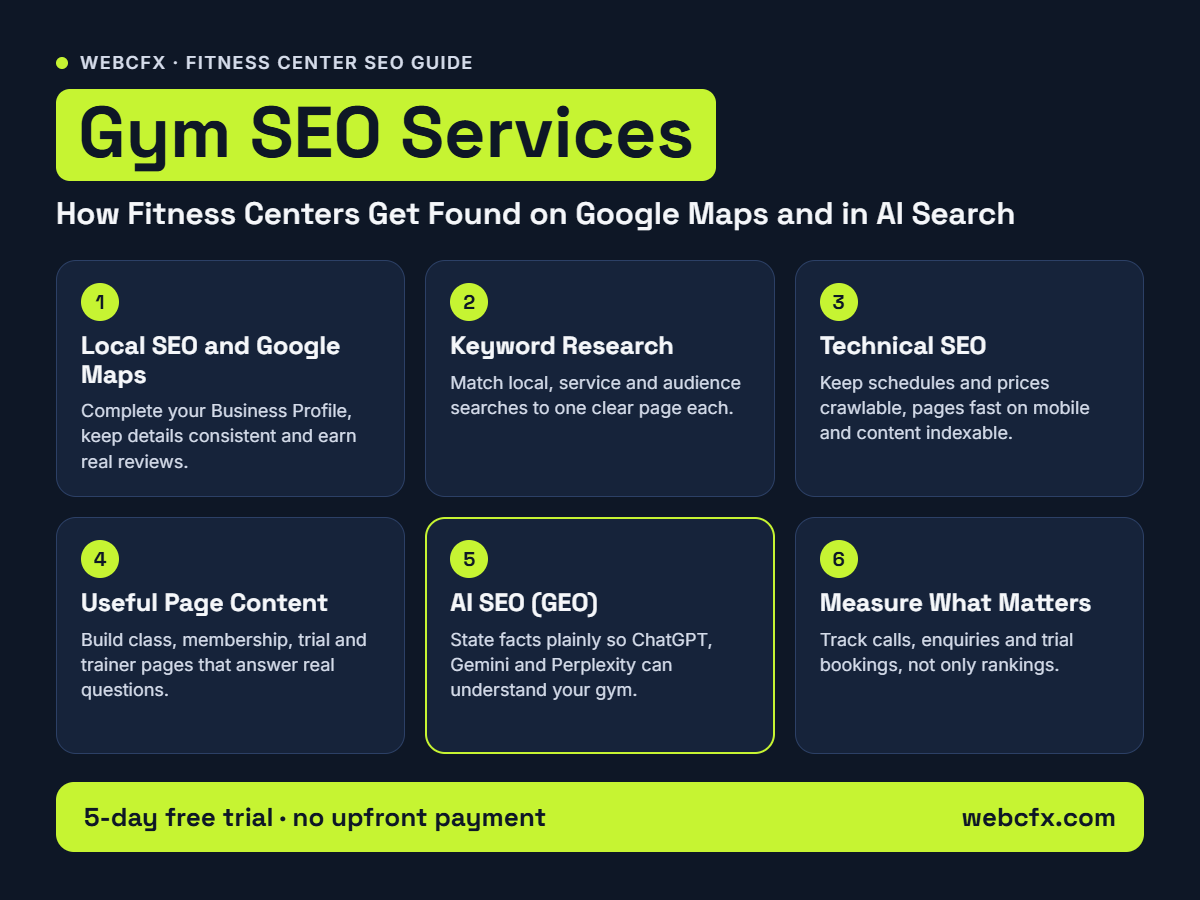
- Relevance: how well your profile matches the search. Choose accurate categories and describe your services in full.
- Distance: how far you are from the searcher. You cannot move your gym, but you can state clearly which neighborhoods you serve.
- Prominence: how well known you are. Google says more reviews and positive ratings can improve local ranking, and links from other websites also play a part.
Use this checklist for Google Maps SEO for fitness centers:
- Claim and verify your Business Profile.
- Pick the right primary category, such as gym or yoga studio, and add secondary categories that apply.
- Add services, classes, opening hours, holiday hours, photos and a trial or booking link.
- Keep your name, address and phone number identical on your website and in local citations and business directories.
- Ask real members for reviews and reply to every one.
- Link the profile to the most relevant landing page, not always the homepage.
How Local Gym Search Differs by Market
Gym owners often look for help in their own market. A gym owner searching for SEO for gyms in New York, a gym SEO agency in Chicago or fitness studio SEO in Austin faces dense competition. Someone comparing gym SEO services in Toronto, a gym marketing agency in Sydney or a fitness centre SEO company in Manchester meets different directories, spelling and customer habits.
Language and terms matter too. A Montreal studio may need French and English pages. A Berlin gym needs German content. UK, Canadian and Australian gyms often use “fitness centre”, while US searchers use “fitness center”. Your pages should match the words local members use.
Location Pages for Multi-Location Gyms
Multi-site operators need one strong page for each real location. A good gym location page optimization plan gives every page its own useful details:
- Full address, map, parking and public transport notes.
- The classes, trainers and equipment available at that site.
- Local reviews and photos taken at that location.
- Neighborhoods and nearby business districts the site serves.
- Questions members ask about that specific gym.
Avoid thin pages that swap only the city name. Do not create pages for areas you do not serve. Both habits add little value and can weaken your site.
Technical SEO for Fitness Websites
Technical SEO makes sure search engines can crawl, render and index your pages. In plain terms, it removes obstacles between your content and the people searching for it.
- Mobile and speed: most members browse on phones. Compress images and video, and check page speed on mobile.
- Crawlable content: keep class schedules and pricing as readable page text, not only inside embedded widgets.
- Indexability: check that no page is blocked by robots.txt or tagged noindex by mistake.
- XML sitemap: list your important pages so search engines can find them.
- Structured data: use a local business type, such as ExerciseGym, and make sure the markup matches what visitors can see.
- Internal links: link class pages, location pages and the trial page to each other.
Most gym website optimization services start with a fitness studio website SEO audit, which lists these problems in order of priority.
On-Page SEO and Fitness Content Optimization
On-page SEO tells search engines and visitors what each page offers. Every important page needs a clear title, one H1, descriptive subheadings and a single main purpose.
Strong gym pages usually include:
- Class pages: who the class is for, level, length, what to bring and which trainer leads it.
- Membership page: plans, what is included and how to join.
- Trial page: a short form and a clear next step.
- Trainer profiles: real qualifications and experience, which build trust.
- Helpful articles: honest answers to member questions, linked to the relevant class or trial page.
Fitness website content optimization also means accuracy. Avoid medical claims, and have qualified staff review advice about training or health. Useful, original content tends to serve readers and search engines better than copied or generic text.
Off-Page SEO and Link Building for Gyms
Off-page SEO builds authority beyond your website. For gyms, the best links are local and relevant. Examples include community events, charity runs, local business partnerships, health professionals and local news coverage.
Gym backlink building services should be white-hat and transparent. Avoid paid link schemes, mass directory submissions and networks of low-quality sites. A few relevant local mentions are worth more than hundreds of irrelevant ones.
AI SEO and GEO for Fitness Businesses
Generative engine optimization (GEO), often called AI SEO, makes your content easy for AI search tools to find, understand and reference. It builds on SEO. It does not replace it.
Google’s own guidance on AI features says SEO best practices remain relevant for AI Overviews and AI Mode. It points to allowing crawling, making content findable through internal links, providing a good page experience and keeping important content in text.
| Traditional and local SEO | AI SEO (GEO) | |
|---|---|---|
| Goal | Rank pages and map listings | Be understood and referenced in generated answers |
| Typical search | “gym near me” | “Which gym in my area suits beginners?” |
| Key work | Keywords, Business Profile, links, technical fixes | Clear facts, direct answers, consistent business details, reviews |
| How to track | Rankings, clicks, calls, enquiries | Test prompts, mentions, referral traffic |
| Guarantees | None | None |
How Can a Gym Appear in AI Search Results?
There is no switch to flip and no way to guarantee a mention. You can make your gym easier for AI tools to understand and trust:
- Confirm your pages are indexable and not blocked by robots.txt or your hosting setup.
- State key facts plainly: location, services, who each class suits, trial terms and opening hours.
- Keep your business details consistent across your website, Business Profile and directories.
- Earn genuine reviews and local mentions.
- Publish comparison and question-style content, such as “Pilates or yoga: which suits you?”
- Add short FAQ sections where they truly help visitors.
Improving Visibility in ChatGPT, Gemini, Perplexity and Copilot
Each AI tool draws on different sources, and they change often. Gemini and Google AI Overviews connect closely to Google Search. Microsoft Copilot is closely tied to Bing, so checking your Bing indexing is sensible. Perplexity and similar tools reference web pages, so clear, crawlable pages help.
Test real member questions on each platform every month and record what appears. Treat the results as research, not a ranking report.
Common Gym SEO Mistakes to Avoid
- Targeting only broad terms such as “gym” or “fitness”.
- Ignoring Google Business Profile after setup.
- Building duplicate city pages with no unique content.
- Hiding schedules and prices in images or PDFs.
- Buying cheap backlinks or fake reviews.
- Publishing generic fitness blogs with no link to a class or trial page.
- Tracking rankings only, not calls, enquiries and trial bookings.
- Hiring an agency that promises first-page results.
How to Choose an SEO Agency for Gyms
A good SEO company for fitness studios should explain its work in plain language. Ask these questions before you sign:
- Do you understand local search and Google Maps, not only website SEO?
- Which services are included: technical SEO, on-page, off-page, content, AI SEO?
- How will you report progress, and how often?
- Can I see examples of your work and talk to existing clients?
- Is there a trial or a short commitment before a long contract?
- Who owns the website changes, content and accounts if we stop?
Warning signs include guaranteed rankings, secret methods, no reporting and pressure to sign quickly. Pricing depends on the number of locations, local competition, website condition and the scope of work. Ask for a written scope instead of a single headline price.
How to Measure Gym SEO Performance
Track business outcomes, not only rankings:
- Google Search Console: impressions, clicks, queries and average position.
- Website analytics: organic visits, trial form submissions and membership enquiries.
- Business Profile performance: calls, direction requests and website clicks.
- Call tracking: which searches lead to phone enquiries, where tracking is available.
SEO usually takes months to show clear results, and timing varies by market and competition. A monthly report that links work to enquiries keeps everyone honest.
How WebCFX Can Help Fitness Centers and Gyms
WebCFX provides SEO, local SEO, technical SEO, on-page SEO, off-page SEO and AI SEO (GEO) for business categories including fitness centers, gyms, studios and health clubs. Its focus is organic visibility, relevant traffic and a long-term online presence, with no promise of specific rankings.
Fitness owners can review WebCFX’s client work and start with a trial before committing to a long-term plan.
Frequently Asked Questions
How long does SEO take to improve gym website rankings?
Most gyms need several months to see clear movement. Timing depends on competition, website condition, local demand and the work completed. Technical fixes and Business Profile updates can show effects sooner than content and link building.
How much does SEO cost for a gym?
There is no single price. Cost depends on the number of locations, how competitive your area is, the state of your website and whether you need content, links and AI SEO. Ask for a written scope and a clear reporting plan.
Why is my gym website not ranking on Google?
Common causes include blocked or non-indexed pages, thin class and service pages, weak local signals, duplicate location content and few reviews or links. A fitness studio website SEO audit finds which of these apply to you.
How can a gym compete with large fitness chains online?
Compete on specifics. Target local, audience and class searches, build unique location pages, collect real reviews and show what makes your gym different. Chains win broad terms, but local detail is hard for them to copy.
Is AI SEO important for fitness businesses?
It is becoming useful, because people now ask AI tools for gym recommendations. AI SEO builds on strong SEO, clear content and consistent business details. It cannot guarantee mentions or citations.
How can personal training studios attract local customers?
Create a clear page for each service, show trainer qualifications, keep your Business Profile active and collect reviews. Add neighborhood details and a simple booking route so local searchers can act quickly.
What keywords should fitness centers target?
Start with local and service terms such as “gym in [neighborhood]”, “Pilates classes near me” or “personal training studio”, then add audience terms such as “women’s gym”. Map each keyword to one page.
Conclusion
Gym SEO services work best when they combine local search, a well-built website and clear content that people and AI tools can understand. SEO for fitness businesses is not about one trick. It is a steady process of being the most useful, trusted answer when someone searches for a gym.
If you are choosing an SEO agency for gyms, look for clear scope, honest reporting and a way to see real work before committing.
Ready to Grow Your Fitness Business Through SEO and AI Search?
Improving your organic search visibility can create more opportunities to reach people searching for a gym in your area.
WebCFX provides SEO and AI SEO (GEO) services to help fitness businesses improve Google rankings, attract relevant organic traffic and build visibility across AI search platforms such as ChatGPT, Gemini and Perplexity.
Explore Our Client Experience: https://webcfx.com/latest-clients/
You can start with our 5-day free trial with no upfront payment. During the trial you can review the SEO work being completed, receive the first work report and evaluate the results before the first billing.
Choose Your Free Trial Plan: https://webcfx.com/seo-packages/
Have questions? Contact our team on WhatsApp: https://wa.me/919569951031
Visit https://webcfx.com/ to learn more about our SEO and AI SEO services.


