
SEO for Multi-Location Fitness Centers: How Gyms Win Local Search and AI Visibility
SEO for multi-location fitness centers is the work of making every branch easy to find, trust and join through Google, Bing and AI search tools. A gym with five locations does not have one search problem. It has five, and each one has its own neighbourhood, competitors, reviews and opening hours.
Many gym groups treat the website as one brochure with a list of addresses. Search engines and members see something different. They look for a clear page, a verified listing and accurate details for the branch nearest to them.
This guide explains how gym owners, health club operators, boutique fitness studio groups, franchise owners and marketing managers can build that visibility. It covers location pages, Google Business Profiles, technical SEO and AI SEO (also called GEO). It also shows how WebCFX supports fitness businesses that want more local enquiries, trial bookings and membership sign-ups.
What Makes SEO for Multi-Location Fitness Centers Different?
A single gym competes in one local market. A multi-location group competes in several at once, and its own branches can compete with each other. Each branch needs its own search presence. The brand also needs one consistent identity across all of them.
That creates three jobs that a single-site gym never faces:
- Branch-level visibility. Each location must appear for searches near its own address.
- Brand-level consistency. Names, categories, services and details must match everywhere.
- Scalable content. You need useful pages for many locations without copying the same text.
Standard gym SEO still applies. Our overview of gym SEO services and our guide to SEO for fitness centers cover the single-location basics. This article focuses on what changes when you have several branches.
Common Challenges Multi-Location Gyms Face
Most multi-location fitness businesses run into the same problems:
- One generic page for all locations. A single “Locations” page with addresses gives search engines little to rank for each branch.
- Thin, templated location pages. Pages that only swap the city name add no value for members.
- Inconsistent business details. Different phone numbers, hours or names across listings confuse both people and search systems.
- Unmanaged Google Business Profiles. Duplicate, unverified or outdated profiles weaken trust.
- Booking tools that hide content. Class timetables loaded in ways search engines cannot read leave pages looking empty.
- Heavy dependence on paid ads. Some groups pay for every trial booking because organic search brings few.
- Branches with unequal reviews. One strong location can sit beside a weak one with few recent reviews.
- Little presence in AI search. Details are scattered, so AI tools have nothing clear to summarise.
Why Organic Search Visibility Matters for Each Branch
Gym searches are local and comparison-driven. People look for a gym, a studio or a class near home or work. They then check reviews, opening hours, photos, pricing and whether a trial is available.
A member rarely chooses a brand in the abstract. They choose a branch. If your downtown branch has no page, an incomplete profile and no recent reviews, it loses to a competitor that makes the decision easy.
Organic visibility also builds over time. Paid ads stop when the budget stops. Well-built location pages, accurate profiles and good content can keep supporting enquiries without a per-click cost, although results vary and nothing is guaranteed.
How to Build Location Pages That Are Not Doorway Pages
Every real branch should have its own page at a stable URL. The risk is creating many near-identical pages only to catch city searches. Google’s spam policies describe doorway abuse as pages made to rank for similar queries that send people to a less useful destination. See Google’s spam policies.
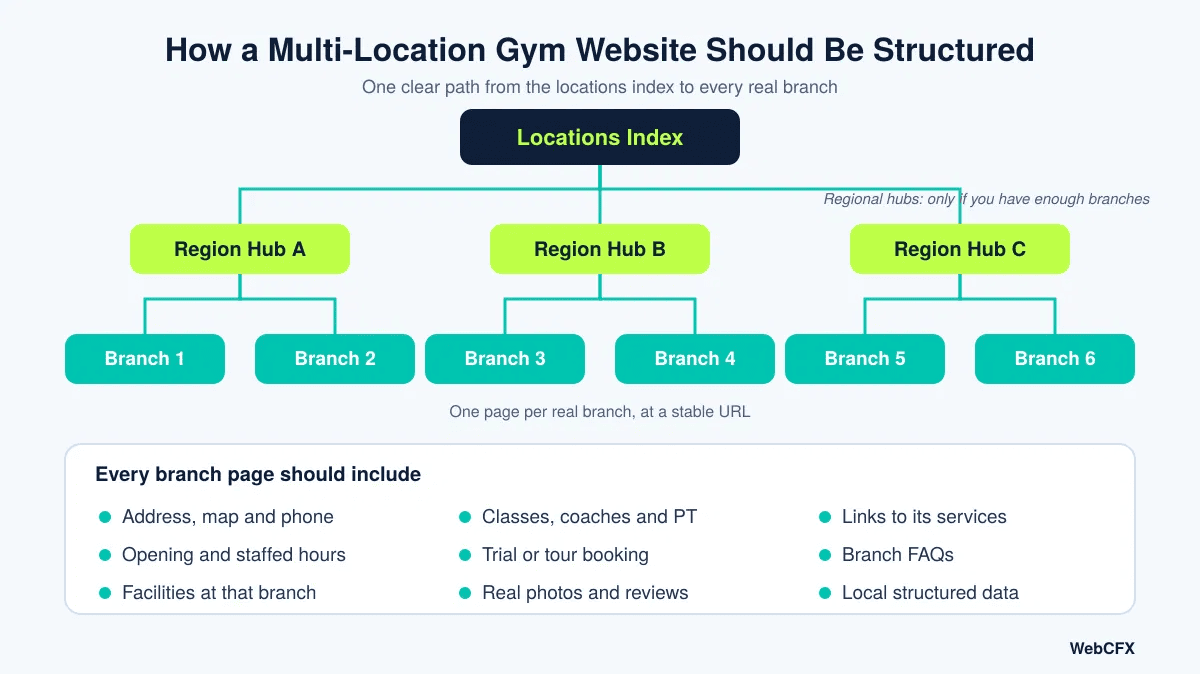
A safer structure looks like this:
- A locations index linked from the main navigation or footer.
- Region or city hubs, only if you have enough branches to need them.
- One page per real location with unique, useful content.
- Links between each location and the services offered there.
What a useful gym location page includes
- Full address, phone number, map and parking or transport details
- Opening hours, including staffed hours for 24-hour gyms
- Facilities and equipment that are actually at that branch
- Classes, coaches and personal training available there
- Local membership options and a clear trial or tour booking step
- Photos of that branch, not generic stock images
- Reviews or feedback collected for that location
- Nearby landmarks, public transport and neighbourhood context
- Questions members commonly ask about that specific branch
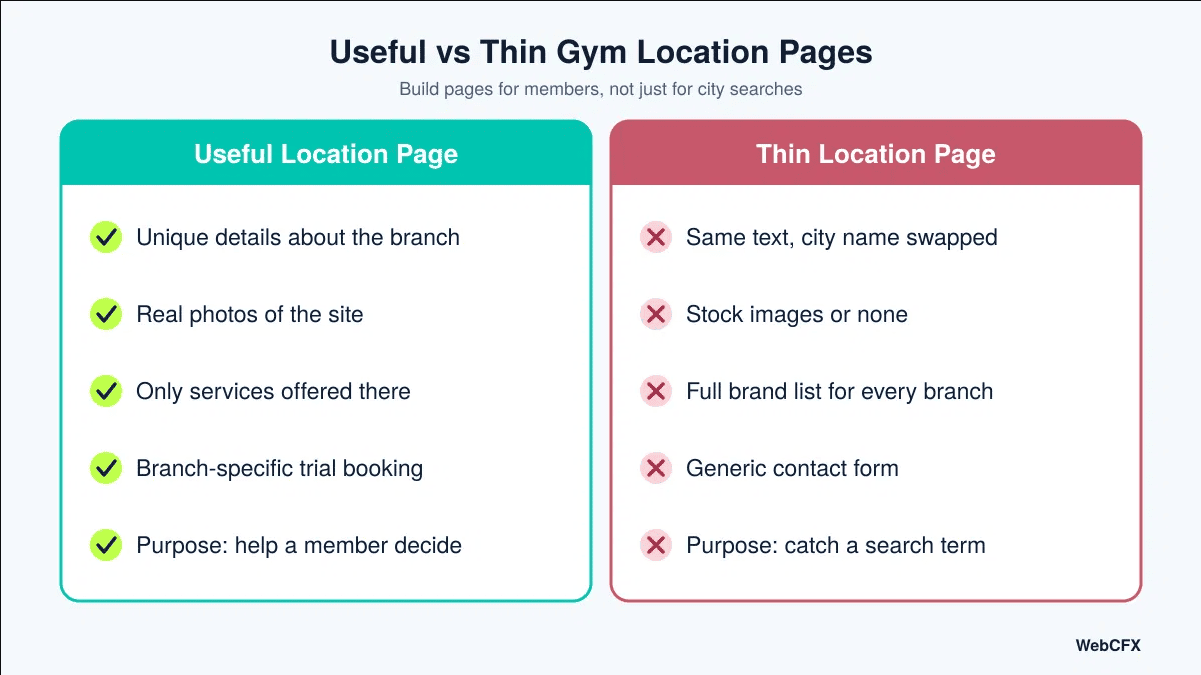
Useful page versus thin page
| Feature | Useful location page | Thin location page |
|---|---|---|
| Content | Unique details about the branch | Same text with the city swapped |
| Photos | Real photos of the site | Stock images or none |
| Services | Only what that branch offers | Full brand list for every branch |
| Booking | Branch-specific trial or tour link | Generic contact form |
| Purpose | Help a member decide | Catch a search term |
If a branch has nothing unique to say yet, build the page when you have real information. Do not create pages for towns where you have no gym or defined service area.
Google Business Profile for Multiple Gym Locations
Your Google Business Profile is often the first thing a local searcher sees. For a multi-location gym, accuracy matters more than volume.
Follow Google’s guidelines for representing your business on Google. They say not to create more than one profile for each location. Then apply these practices:
- Use one verified profile per real branch and remove duplicates.
- Keep the business name consistent with how the branch presents itself in real life.
- Choose the most accurate primary category, such as gym or yoga studio, and add secondary categories carefully.
- Link each profile to its own location page, not the homepage.
- Keep hours, holiday hours, phone number and services current.
- Add real photos of the entrance, equipment, studios and classes.
- Respond to reviews at branch level, including critical ones.
Do not offer free passes or discounts in exchange for reviews. Google’s review policies do not allow incentivised reviews.
Local Search Queries Gym Owners Should Understand
Search language differs by market. The examples below are query patterns, not search-volume data. Always validate them with a keyword tool and your own Search Console data.
| Market | Example query patterns |
|---|---|
| US | “24-hour gym in Austin, Texas”, “Pilates studio near downtown Los Angeles” |
| UK | “gym in Manchester with personal trainers”, “yoga studio in London” |
| Canada | “CrossFit gym in Calgary, Alberta”, “gym in Toronto with day pass” |
| Australia | “gym near me in Brisbane, Queensland”, “group fitness classes Brisbane” |
| Europe | “Fitnessstudio München, Bavaria”, “sportschool Amsterdam, North Holland” |
If you serve several languages, use the term local members actually use. Examples include Fitnessstudio in Germany, salle de sport in France, gimnasio in Spain, palestra in Italy and sportschool in the Netherlands. If you publish translated pages, implement hreflang correctly.
Neighbourhood context also matters. A business-district branch may attract lunchtime and early-morning members. A suburban branch may attract families and evening classes. A university-area branch may attract students looking for flexible plans. Say so in the page copy where it is true.
Technical SEO for Multi-Location Fitness Centers
Technical SEO makes sure search engines can reach and understand every branch page. For multi-location sites, check these areas first.
Crawlability and indexing. Location pages must return a normal page, be linked internally and sit in the XML sitemap. Check that robots.txt and noindex tags are not blocking them.
Readable class and pricing content. If timetables or pricing load only through a third-party widget, add key details as visible text on the page as well.
Structured data. Use LocalBusiness structured data, or a more specific type such as ExerciseGym, on each location page. Match it to the visible content. See Google’s local business structured data guide. Structured data helps search engines understand a page. It does not guarantee a rich result.
Page experience. Most gym searches happen on mobile. Make sure booking buttons, maps and phone links work well on small screens.
Duplicate and closed locations. Merge or redirect pages for closed branches. Do not leave outdated pages live.
Internal linking. Link the locations index to each branch, each branch to its services, and service pages back to the branches that offer them.
Content That Helps Gyms Convert Searchers into Members
Rankings only matter if visitors take action. Each location page should make the next step obvious.
- Show a clear trial, tour or class-booking button above the fold.
- Explain what happens on a first visit.
- State plan types and what is included, where pricing can be shown.
- Introduce coaches and trainers with relevant qualifications.
- Describe classes in plain language for beginners.
- Answer branch-specific questions about parking, showers, childcare or accessibility.
Personal training studios, yoga studios, Pilates studios and CrossFit facilities should create pages for each core service. Do this only if the service is real and the page can say something useful.
How AI SEO (GEO) Helps Multi-Location Gyms Get Found
AI SEO, also called Generative Engine Optimization (GEO), focuses on making your information clear and trustworthy for AI-assisted search. Members now ask conversational questions such as “Which gym near me has a Pilates studio and a free trial?” in Google AI Overviews, Google AI Mode, ChatGPT, Gemini, Perplexity and Microsoft Copilot.
Google states that no extra requirements or special optimisation are needed to appear in AI Overviews or AI Mode, and that standard SEO best practices still apply. A page must be indexed and eligible to appear in Search with a snippet. Read Google’s guide to AI features and your website.
Other AI tools work differently and do not publish the same rules, so treat all AI visibility as something you can support, not control. These steps help:
- Answer questions directly. Put a short, factual answer under each question heading.
- Keep facts consistent. Hours, services, addresses and pricing should match across your site, profiles and directories.
- Use clear entities. Name the branch, the neighbourhood, the services and the facilities plainly.
- Add real comparisons. For example, explain the difference between a 24-hour gym and a staffed health club, or between group classes and personal training.
- Show expertise. Include coach profiles, qualifications and accurate fitness guidance.
- Make content easy to read. Use short paragraphs, descriptive headings, lists and tables.
Traditional SEO and GEO support each other. Strong crawlability, reviews and useful content help both. No agency can guarantee citations in any AI tool.
Common SEO Mistakes Multi-Location Gyms Should Avoid
- Building city pages for towns where no branch or service area exists
- Copying one page template and changing only the location name
- Pointing every Google Business Profile to the homepage
- Using different business names across listings
- Ignoring branches with fewer reviews
- Leaving closed or moved locations online
- Hiding class schedules inside content search engines cannot read
- Tracking only total website traffic instead of branch-level results
- Writing for AI tools instead of for members
- Buying low-quality backlinks or directory spam
How to Build a Long-Term Strategy for Multi-Location Gym SEO
A practical plan moves in stages:
- Audit. Review profiles, location pages, indexing, duplicate listings and competitors in each market.
- Fix the foundation. Correct business details, technical issues and site structure.
- Improve location pages. Add real, unique branch content and clear booking steps.
- Strengthen local signals. Maintain consistent citations, collect genuine reviews and earn relevant local links.
- Publish helpful content. Cover beginner guides, class explainers and training advice that match search intent.
- Measure by branch. Use Google Search Console, Business Profile insights and booking data.
Review results regularly and adjust each location to its market. Search results change, so treat SEO as an ongoing process.
How WebCFX Can Help Multi-Location Fitness Centers
WebCFX provides SEO and AI SEO (GEO) services for businesses that want stronger organic visibility. For gyms and fitness studios, that can include local SEO for gyms, technical SEO, on-page SEO, location-page planning and content optimisation.
Our work starts with how people in each market search for fitness services. We then look at your site structure, profiles, content and competitors. We recommend improvements that match your real branches, not templates built for volume.
You can see examples of our work on our client portfolio page.
Frequently Asked Questions
How do multi-location gyms rank in each city?
Each branch needs its own useful page, a verified Google Business Profile, consistent business details and local reviews. The profile should link to the matching location page. Google decides rankings, and results are not guaranteed.
Should every gym branch have its own page?
Yes, every real branch should have its own page with unique details such as address, hours, facilities, classes and booking options. Do not create pages for places where you have no gym or service area.
Can one website support several gym locations?
Yes. One site can work well if it uses a clear structure: a locations index, optional regional hubs and one page per branch. Each page should be useful in its own right.
Is Google Business Profile important for gyms?
It is one of the most visible local search assets for gyms. Accurate hours, categories, photos, reviews and a link to the right location page help people choose a branch and take action.
How do I get my gym recommended by AI tools like ChatGPT or Gemini?
No one can guarantee recommendations. You can improve your chances by keeping details consistent, publishing clear, helpful pages, earning real reviews and making sure your site is crawlable and indexed.
What is GEO for gyms?
Generative Engine Optimization is the practice of making your content clear, accurate and easy for AI-assisted search tools to understand and use. It builds on strong SEO rather than replacing it.
How long does gym SEO take?
Timing depends on competition, site condition and the markets involved. Technical fixes can be quick to make, but ranking changes usually take time. Be wary of anyone promising fixed results.
How do I stop my locations competing with each other?
Give each branch distinct content and a clear service area. Avoid near-duplicate pages. Use internal links and a clear structure so search engines understand which page serves which location.
Conclusion
SEO for multi-location fitness centers works best when every branch is treated as a real local business inside one trusted brand. Useful location pages, accurate Google Business Profiles, sound technical SEO and clear information for AI search all support that goal.
The aim is not to create more pages. It is to help the right person find the right branch and book a visit with confidence.
Ready to Grow Your Gym Locations Through SEO and AI Search?
Whether you run two studios or twenty clubs, improving your organic search visibility can create more opportunities to reach nearby members. WebCFX provides SEO and AI SEO (GEO) services to help businesses improve Google rankings, attract relevant organic traffic and build visibility across AI search platforms such as ChatGPT, Gemini and Perplexity. We do not guarantee rankings, traffic, leads or AI citations.
Explore Our Client Experience: https://webcfx.com/latest-clients/
You can start with our 5-day free trial with no upfront payment. During the trial, you can review the SEO work being completed, and the first work report is shared during the trial period. You can evaluate the work before the first billing and then choose a suitable SEO or SEO + AI SEO plan.
Choose Your Free Trial Plan: https://webcfx.com/seo-packages/
Have questions? Contact our team on WhatsApp: https://wa.me/919569951031
Visit https://webcfx.com/ to learn more about our SEO and AI SEO services.


