
Local SEO for Career Coaches: How to Get More Clients in Your City and Online
Local SEO for career coaches is the work of making your practice easy to find when people search for help in their city, region or time zone. A mid-career manager typing “career change coach in Toronto” or “executive coach London” is ready to act. If your Google Business Profile, service pages and reviews are missing or unclear, another coach gets that consultation request.
Most coaches rely on referrals, LinkedIn and paid ads. Those channels work, but they stop when your effort stops. Local search keeps working once the right pages and profiles are in place.
This guide is for coaches and coaching firms in the USA, UK, Canada, Australia and Europe. It shows how to get more career coaching clients from Google Maps, local search and AI answers. No one can guarantee rankings, leads or AI citations, so it also covers what is realistic.
Local SEO for Career Coaches guide cover with a map search for a career coach, map pins and local results
What Is Local SEO for Career Coaches?
Local SEO for career coaches is a set of actions that help your practice appear in location-based searches, including Google Maps, the local pack and regional organic results. It combines a Google Business Profile (where you qualify), useful service and location pages, consistent business details, reviews and technical basics.
General SEO helps people anywhere find you. Local SEO helps nearby and region-specific clients choose you. For the wider picture, read our guide to SEO for career coaches.
Do Career Coaches Really Need Local SEO?
Not every coach does. A coach with a global audience and no regional angle may gain more from niche content than from city pages. But many coaches have a local or regional angle, even when sessions run on video:
- Clients often prefer a coach in their own country, time zone or professional market.
- In-person workshops, corporate programs and outplacement support are tied to a place.
- Job markets, salary norms and hiring practices differ by country and city.
- “Near me” and city searches usually signal strong intent.
- HR teams may look for a coach who understands the regional job market.
Local SEO also builds trust. A complete profile, steady reviews and a clear service area show prospects that you are real, active and relevant.
Common Local Visibility Problems for Career Coaches
Most coaching websites look polished but bring few local inquiries. The causes are usually practical:
- No Business Profile, or one created without checking Google’s eligibility rules.
- One generic “Services” page covering interview coaching, career change and executive coaching together.
- Vague positioning such as “I help you reach your potential,” which matches no real search.
- Inconsistent details. The business name, address or phone number differs between the website, directories and social profiles.
- Few reviews and no routine for asking satisfied clients.
- Near-identical city pages with only the place name changed.
- No proof. Credentials, method and permission-based testimonials are missing.
- Weak mobile experience, with slow pages or a booking widget that hides key content.
How Do Clients Search for a Career Coach Locally?
Search wording changes with the client’s situation. Matching each search to a dedicated page or profile is the core of local SEO for career coaches.
| Client situation | Example search | Best page or asset |
|---|---|---|
| Wants someone nearby | career coach near me | Google Business Profile and contact page (if eligible) |
| Needs a specialist in their city | career change coach in Toronto | Service page with real location detail |
| Senior professional | executive coach London | Executive coaching page with credentials |
| Interview coming up | interview coaching Sydney | Interview coaching service page |
| Comparing options | how much does a career coach cost | FAQ or pricing explainer page |
| Asking an AI assistant | Who is a good career coach for engineers in Chicago? | Clear, factual page naming niche, location and process |
Wording also changes by country. UK, Australian and many European English-language searchers type “career counselling” and “centre.” US searchers type “career counseling” and “center.” Canadian English mixes both. Match your audience, and keep “optimisation” or “optimization” consistent across a page.
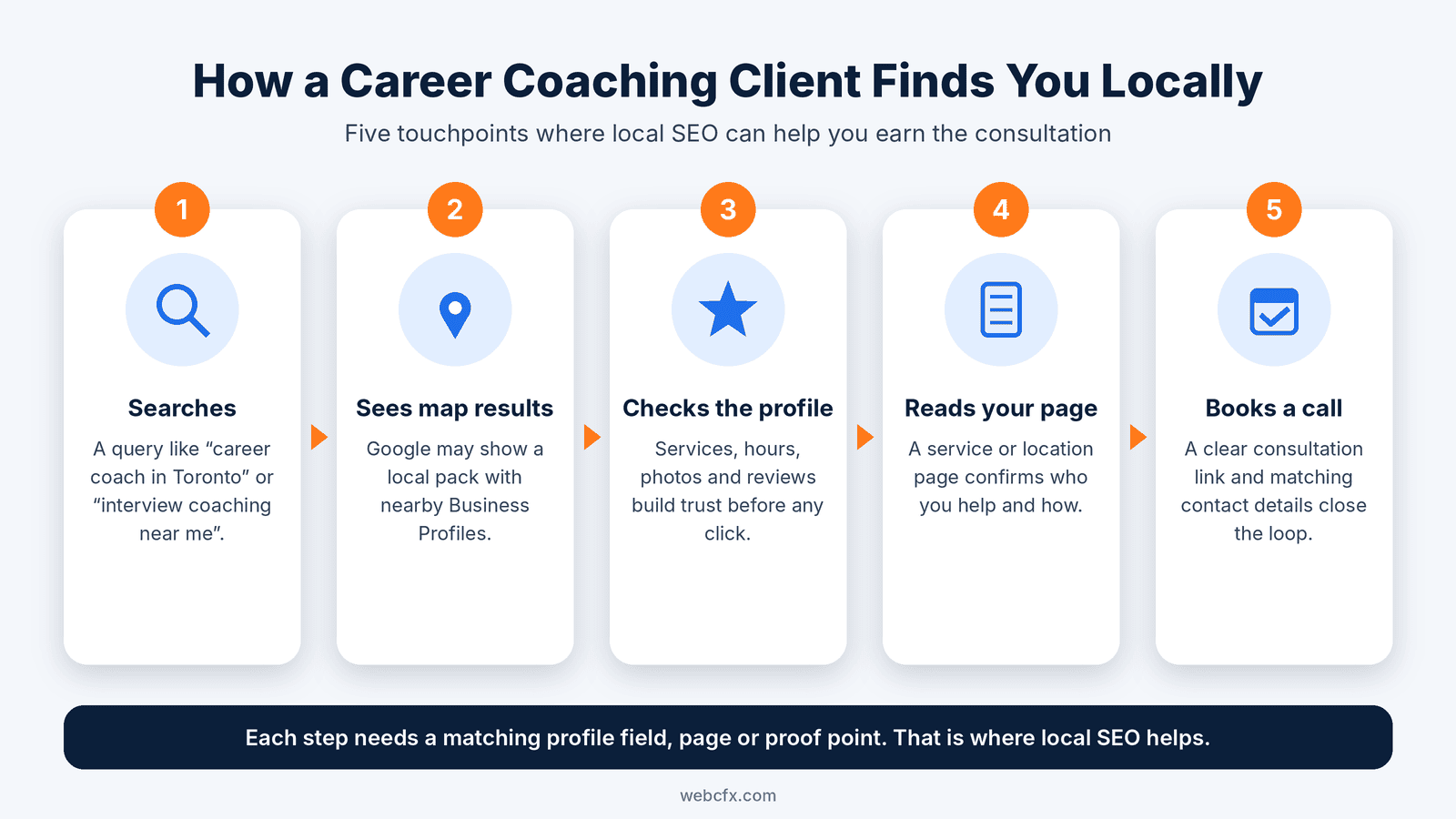
Five-step diagram of how a client finds a career coach locally: search, map results, profile, web page, booking
Google Business Profile for Career Coaches: Who Qualifies?
A Google Business Profile helps you appear in Google Maps and local results. Google’s business eligibility guidelines say a business needs in-person contact with customers during its stated hours. They list online-only businesses as ineligible.
So a coach with an office, a rented room or regular in-person sessions may qualify. A purely online coach may not. If you travel to clients, read the guidelines for service-area businesses and check your own case. Never list an address where you do not actually meet clients.
If you do not qualify, you can still build local relevance through your website, directories and content.
How to Optimize Your Profile if You Are Eligible
- Use your real business name and an accurate address or service area.
- Choose the most accurate primary category, and add others only where they truly apply.
- List each service, such as career change coaching, interview coaching and executive coaching, with a short plain description.
- Add hours, a phone number and an appointment link pointing to your most relevant page.
- Upload real photos of your space, your sessions and yourself.
- Write a clear description of who you help, without exaggeration.
- Keep every detail identical to your website.
- Review the profile monthly and update it when anything changes.
What Drives Local Rankings for Career Coaches?
Google says local results depend mainly on relevance, distance and prominence. It also says there is no way to pay for a better local ranking.
| Factor | What Google means | What a career coach can do |
|---|---|---|
| Relevance | How well your profile matches the search | Complete services, categories and descriptions |
| Distance | How far you are from the searcher | Keep your address or service area accurate; you cannot change the searcher’s location |
| Prominence | How well known you are, including reviews and links | Earn real reviews, reply to them, and earn relevant links and mentions |
How to Build Location Pages That Help Clients, Not Just Rankings
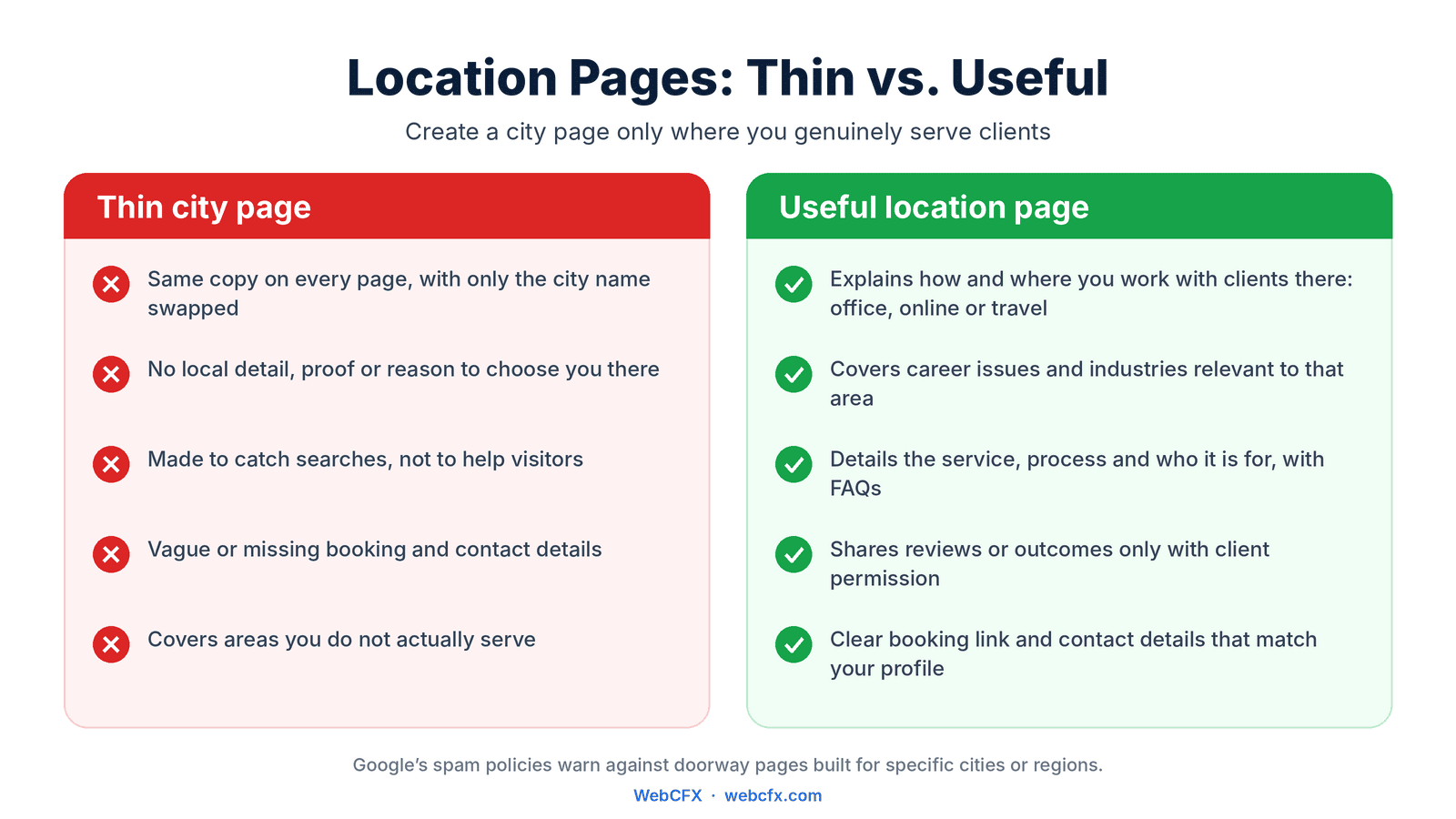
Coaches who serve several cities are tempted to publish one page per city with only the place name swapped. Google’s spam policies describe doorway abuse as pages made to rank for similar searches that send users to less useful intermediate pages. Near-duplicate pages aimed at specific cities or regions are among the examples.
Create a location page only where you genuinely serve clients. Then give it real substance:
- Where and how you work with clients there: office, online, travel or on-site corporate sessions.
- Career issues and industries relevant to the area, based on what you actually see in your practice.
- The service, the process, session formats and who the page is for.
- Reviews or outcomes, shared only with client permission.
- A short FAQ with answers specific to that market.
- A booking link and contact details that match your Business Profile.
Side-by-side checklist comparing thin city pages with useful location pages for career coaches
Which Cities and Regions Should You Target?
Choose places you serve, not places you wish to rank in. The examples below are common coaching markets, not a checklist.
| Country | Example metro areas | Region level (only where relevant) |
|---|---|---|
| USA | New York, Chicago, Austin, San Francisco, Boston, Seattle | New York, Illinois, Texas, California, Massachusetts, Washington |
| UK | London, Manchester, Birmingham, Edinburgh | England, Scotland |
| Canada | Toronto, Vancouver, Calgary, Ottawa | Ontario, British Columbia, Alberta |
| Australia | Sydney, Melbourne, Brisbane | New South Wales, Victoria, Queensland |
| Europe | Dublin, Amsterdam, Berlin | Country pages for markets you actively serve |
A coach based in one city who also serves a wider region often needs one strong city page and one regional page, not ten thin ones. Online coaches serving a whole country can focus on niche and audience instead, such as “career coach for software engineers.” Life coaches face a similar choice, which we cover in our guide to local SEO for life coaches.
Local Citations and Consistent Business Information
A citation is a mention of your business name, address and phone number on another site. Consistent details help search engines and people trust that your practice is real and current.
- Choose one exact format for your name, address, phone number and website, and reuse it everywhere.
- Prioritize relevant sources: professional coaching associations, chambers of commerce, reputable local directories and your LinkedIn profile.
- Fix duplicate and outdated listings.
- Skip bulk directory submissions. They add little and carry risk.
- If you coach online and publish no address, keep your name, website and contact details identical across every profile.
Local Content and Proof That Build Trust
Coaching is a trust purchase. Google’s guidance on helpful, reliable, people-first content points to experience, expertise, authoritativeness and trust, and names trust as the most important. For coaches, that means showing real proof:
- A detailed bio with credentials, industries coached and years of practice.
- A named author on every article.
- A process page that explains the first call, the plan and the sessions.
- Genuine, anonymized client scenarios shared with permission. Never invent them.
- Local content from real knowledge, such as career-change guides for a regional industry you know, or interview preparation for employers in your area.
- Relevant links earned through talks, workshops, guest articles and association features.
Technical Local SEO Basics for Coaching Websites
Good local profiles cannot make up for a site that search engines cannot read. Check these basics:
- Indexing. Key pages should be crawlable and free of accidental noindex tags or robots.txt blocks.
- Mobile speed. Many prospects browse on phones, so test pages and your booking widget on mobile.
- Site structure. Use short, readable URLs and a clear path from service page to booking.
- Structured data. If you have a real business address, consider LocalBusiness structured data. Google lists name and address as required properties, and says structured data does not guarantee any search feature. Mark up only what is visible on the page.
- Security. Use HTTPS on every page.
- Monitoring. Use Google Search Console to watch indexing problems and the queries that bring visitors.
How AI SEO (GEO) Supports Local Career Coach Visibility
Clients now also ask ChatGPT, Gemini, Perplexity and Microsoft Copilot questions such as “Who can help a software engineer move into management in Dublin?” AI SEO, also called generative engine optimization (GEO), makes your practice easier to understand and cite in answers like that. It builds on traditional SEO rather than replacing it.
Google says appearing in AI Overviews and AI Mode requires nothing beyond standard Search eligibility. The page must be indexed and able to show with a snippet. Google also says no special optimizations are necessary, and that no page is guaranteed to be crawled, indexed or shown.
So the practical work is the same strong foundation, stated clearly:
- Answer questions directly. Open a section with a clear two-sentence answer, then add detail.
- State facts in readable text. Put your niche, location or service area, credentials, session formats and booking steps in page text, not only in images or PDFs.
- Keep your identity consistent. Use the same business name and description on your website, directories, LinkedIn and association profiles.
- Support claims. Link to credible sources and show first-hand experience.
- Use clear structure. Short headings and small comparison tables, such as career coach vs. recruiter vs. mentor, are easy for people and machines to read.
- Check indexing. Watch your pages in Google Search Console and Bing Webmaster Tools.
- Test it. Ask each AI tool a question a client would ask and note which sources appear. Results vary by query, time and user, so treat them as directional.
No agency can promise a mention in an AI answer. For a deeper look, read our guide to AI SEO for career coaches.
Common Local SEO Mistakes Career Coaches Should Avoid
- Listing an address where you do not actually meet clients.
- Stuffing city names into your business name or page titles.
- Publishing dozens of near-identical city pages.
- Buying or faking reviews, or ignoring the real ones.
- Letting details drift between your profile, website and directories.
- Targeting “career coach” alone instead of specific niches.
- Hiding the booking link or asking for too much on the inquiry form.
- Publishing generic AI-written articles with no personal expertise.
- Skipping Search Console and never checking what works.
- Expecting results in a few weeks.
A 90-Day Local SEO Plan for Career Coaches
| Weeks | Focus | Output |
|---|---|---|
| 1–2 | Audit and research | Eligibility check, niche list, real service areas, keyword-to-page map, indexing issues listed |
| 3–4 | Profile and foundations | Business Profile set up or cleaned (if eligible), consistent business details, mobile booking test |
| 5–8 | Pages and proof | Rewritten service pages, one to three genuine location pages, bio, process and FAQ content, review request routine |
| 9–12 | Content, links and AI checks | Two or three helpful articles, internal links, association or local listings, Search Console review, AI question tests |
Timelines vary with competition, your site’s history and your niche. Treat this as a planning guide, not a promise. Track impressions, clicks, profile actions, inquiry form submissions and booked calls.
How WebCFX Can Help Career Coaches
WebCFX provides SEO and AI SEO (GEO) services for businesses that want stronger organic visibility. For career coaches, professional SEO services can include local keyword research, Business Profile guidance, service and location page optimization, technical SEO review, white-hat link building, content optimization and clear structure for AI search.
Local visibility is a steady source of lead generation for career coaches, and it works alongside other digital marketing for career coaches, such as referrals, LinkedIn and email. The aim is simple: help the right clients find your practice, understand what you offer and book a conversation.
Frequently Asked Questions
Do career coaches need local SEO if they coach online? It depends on how clients search. If they look for a coach by city, region or time zone, or you also meet clients in person, local signals help. If you serve a global audience with no regional angle, focus on niche and audience instead.
Can an online-only career coach have a Google Business Profile? Probably not. Google’s eligibility guidelines list online-only businesses as ineligible. Check them for your own situation, and build local relevance through your website, citations and content.
How many city pages should a career coach create? Only as many as you genuinely serve and can make useful. One strong page with real local detail beats ten near-duplicates, which Google’s spam policies warn against.
How do I get more Google reviews as a career coach? Ask satisfied clients after a successful engagement, share a direct link to your profile, and reply to every review. Never buy, fake or pressure for reviews.
How can career coaches appear in AI search results? No one can guarantee it. Publish indexable, accurate, people-first pages, keep business details consistent across the web and answer client questions directly.
How much does local SEO cost for a career coach? Cost depends on competition, your current website and the scope of work. Ask any provider for a written scope. WebCFX offers a 5-day free trial so you can review actual work before choosing a plan.
Conclusion
Local SEO for career coaches rests on a few honest foundations: an accurate and eligible Google Business Profile, focused service pages, genuinely useful location pages, consistent details and real reviews. Add AI search readiness on top, and your practice becomes easier for both people and search systems to understand.
If you want a team that offers SEO services for career coaches, WebCFX can support the technical, content and local work while you focus on coaching.
Ready to Grow Your Coaching Practice Through SEO and AI Search?
Whether you coach in one city or across a region, better local and organic visibility can create more chances to reach people looking for career guidance.
WebCFX provides SEO and AI SEO (GEO) services to help businesses improve Google rankings, attract relevant organic traffic and build visibility across AI search platforms such as ChatGPT, Gemini and Perplexity. We do not guarantee rankings, traffic, leads or AI citations, but you can review the work.
- Explore our client experience: https://webcfx.com/latest-clients/
- Start with our 5-day free trial, with no upfront payment. During the trial you can review the SEO work being completed, and the first work report is shared in that period. You can evaluate the work before the first billing, then choose a suitable SEO or SEO + AI SEO plan. Choose Your Free Trial Plan: https://webcfx.com/seo-packages/
- Questions? Message our team on WhatsApp: https://wa.me/919569951031
Visit https://webcfx.com/ to learn more about our SEO and AI SEO services.


