
SEO for Career Change Coaches: How to Attract Clients Who Are Ready to Switch Careers
SEO for career change coaches is the process of making your coaching website easy for Google, Bing and AI search tools to find, understand and recommend when someone searches for help switching careers. Career changers behave differently from other coaching clients. They compare options for weeks, worry about cost, age and risk, and often ask an AI assistant before they contact anyone.
A coach who answers those worries clearly appears at the right moment. A coach with one vague services page does not. This guide shows how a career transition coach can build niche service pages, useful content, honest local signals and AI-ready structure.
It focuses on the career change niche. For a broader overview, read our guide to SEO for career coaches.
What Career Changers Search For Before They Book a Coach
Career changers search in stages. Early searches are emotional and broad. Later searches are specific and commercial. Your website needs a page for each stage.
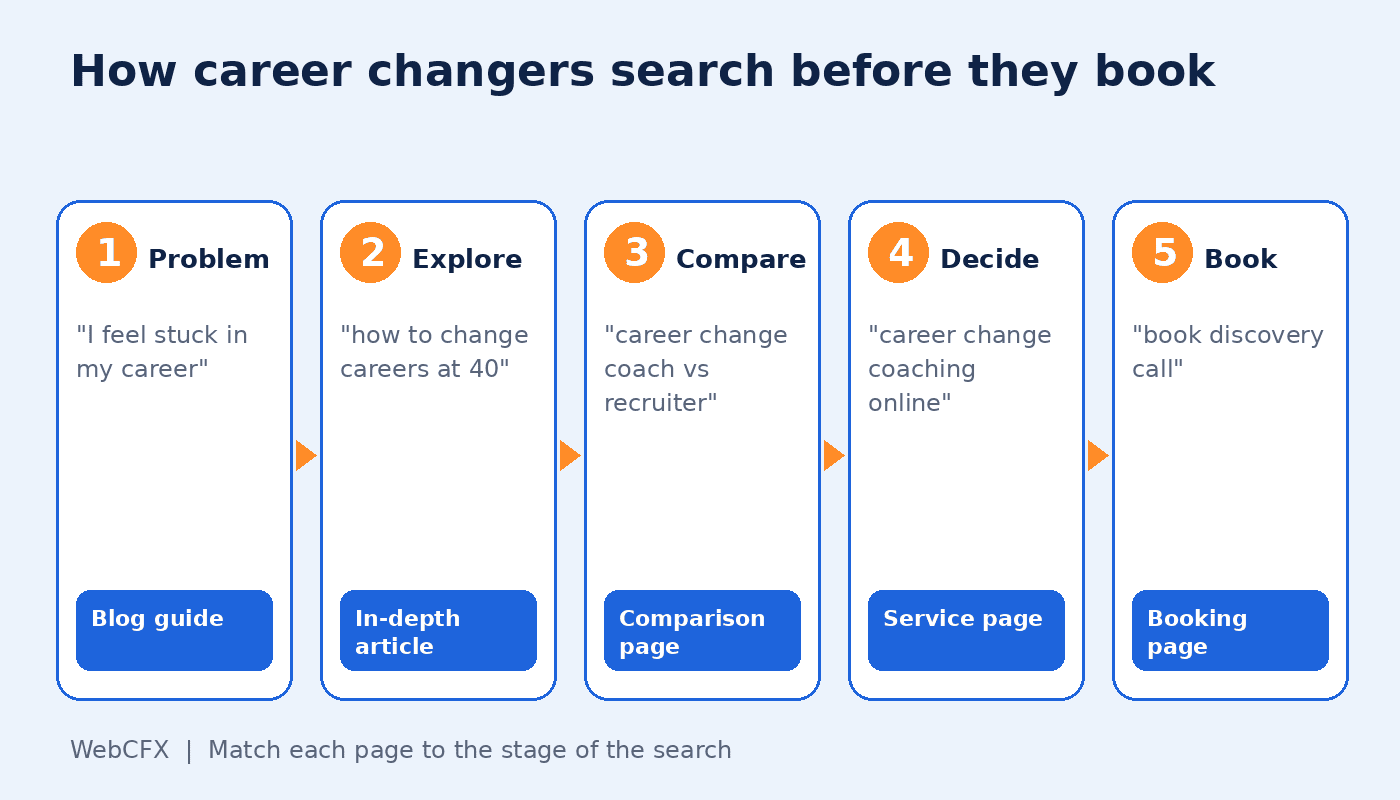
| Stage | Example search | Best page type |
|---|---|---|
| Problem | I feel stuck in my career | Helpful guide |
| Explore | how to change careers at 40 | In-depth article |
| Compare | career change coach vs recruiter | Comparison page |
| Decide | career change coaching online | Service page |
| Cost | how much does a career change coach cost | Pricing or FAQ section |
| Book | book a career change discovery call | Booking page |
A career change coach who covers every stage builds a path from first search to discovery call. Each page should point to the next step.
Career changers are also not one audience. Teachers moving into corporate roles, veterans entering civilian careers, parents returning after a break and engineers moving into management use different words and carry different fears. Your pages should reflect that.
Common Challenges Career Change Coaches Face Online
Many coaching sites look polished but attract few enquiries. The causes are usually practical.
- One broad services page. Career pivot coaching, interview preparation and salary negotiation are separate searches.
- Vague promises. Phrases like “find your purpose” rarely match what people type.
- No visible process. Visitors can’t tell what happens in a session or how long it takes.
- Motivational content only. Posts without practical detail build little authority.
- Unanswered objections. Cost, age, risk and time commitment are hidden or missing.
- Reliance on referrals and social media. Visibility stops when the network goes quiet.
- Unclear facts for AI tools. Credentials, niche and formats sit inside images or long paragraphs.
How to Choose a Niche for Career Pivot Coaching
“Career coach” is a crowded search. “Career pivot coaching for teachers moving into corporate training roles” is narrower and closer to a buying decision.
Choose your niche with evidence:
- List the client groups you have helped most.
- Note the exact words they used on discovery calls.
- Check Google autocomplete and “People also ask” for the same phrases.
- Use Google Search Console to see which queries already show your site.
- Pick niches you can serve credibly, not only those that look popular.
Give a niche its own page only if you have a distinct process, examples and answers for it.
Build Career Change Coaching Pages That Rank and Convert
A strong career change coaching page helps a nervous visitor decide. Use this structure.
-
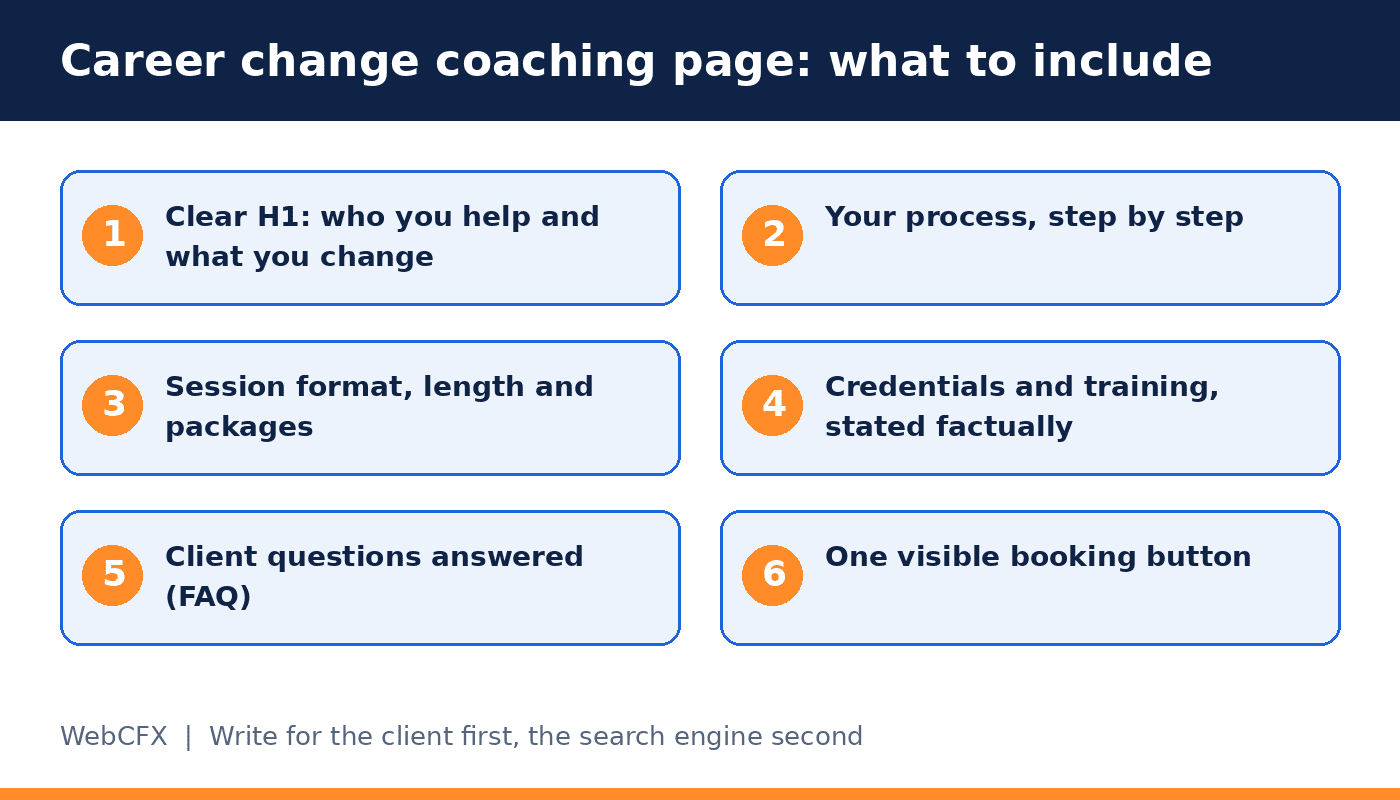
SEO for Career Change Coaches: Get More Clients Online A clear H1. Name who you help and what changes.
- Your process. Describe each step, from career assessment to job search strategy.
- Format and packages. State session length, programme duration and whether you work online or in person.
- Credentials. Share training and experience factually.
- Answers to objections. Cover cost, time, confidentiality and “am I too old to switch?”
- One booking button. Make the discovery call easy to find.
Use one descriptive title tag and one H1. Write for the client first and the search engine second. Add a comparison page such as “how to choose a career change coach” for people still deciding.
Publish Content That Builds Topical Authority
Topical authority means covering one subject thoroughly. For career transition coaching, build a cluster around one pillar guide to changing careers. Support it with focused articles:
- Identifying transferable skills
- Writing a resume for career changers
- Explaining your career change in interviews
- Salary negotiation after a move
- Updating your LinkedIn profile
- Career change coach vs recruiter vs mentor
Link each supporting article to the pillar and to your service page. Add original value: your own frameworks, worksheets and anonymised client scenarios shared with permission. Never invent case studies. Google’s guidance on helpful, people-first content suits experience-led coaching.
Local SEO for Career Change Coaches: When City Pages Make Sense
Local SEO helps only if you meet clients in person or serve a defined area. Google says a business must make in-person contact with customers during its stated hours to qualify for a Business Profile. If you work as an online career coach, you probably aren’t eligible. Don’t use a virtual address to work around this.
If you do qualify, keep your Google Business Profile accurate, choose precise categories and collect genuine reviews. Google says local results rely mainly on relevance, distance and prominence.
Local searches in this niche look like “career change coach in London” or “career transition coaching in Toronto.” Wider searches name regions such as California, Ontario or New South Wales. Create a location page only where you truly serve clients, and add real substance:
- Where you meet clients and how to get there
- Industries and job markets you genuinely know in that area
- Local professional groups or events you take part in
- Client feedback shared with permission
A coach serving New York, Chicago or Austin should not publish three pages with only the city name swapped. The same applies in Vancouver, Sydney or Amsterdam. Remote coaches serving Manchester, Melbourne or Dublin usually do better with audience-focused pages than city pages. Use the spelling your audience uses, such as optimization in the US and optimisation in the UK and Australia.
For a full walkthrough, see our guide to local SEO for career coaches.
AI SEO (GEO) for Career Change Coaches
AI SEO, also called generative engine optimization (GEO), helps AI search tools understand and cite your practice. It builds on classic SEO. Career changers now ask ChatGPT, Gemini, Perplexity and Microsoft Copilot questions like “who can help me change careers at 45?” Google also shows Google AI Overviews and AI Mode in some searches.
Google says no extra requirements or special optimizations are needed to appear in these features beyond SEO fundamentals. The same basics help other AI tools:
- Answer the question in the first sentences of a section.
- State your niche, formats, credentials and service area in plain text.
- Use the same business name and description across your site and profiles.
- Cite credible sources when you make factual claims.
- Keep pages crawlable and linked from your menu or related articles.
- Ask AI tools about your niche and note which sources they use.
Nobody can guarantee a mention. For more detail, read AI SEO for career coaches.
Technical SEO Checks for a Career Coach Website
- Important pages are indexable and free of accidental noindex tags.
- Pages load quickly on mobile. Test with Google PageSpeed Insights.
- URLs are short and readable.
- Booking widgets load reliably and don’t hide key text.
- Schema markup matches visible content.
- The site uses HTTPS.
Google Search Console reports indexing problems and the queries that bring visitors.
Common SEO Mistakes Career Change Coaches Should Avoid
- Targeting only “career coach.”
- Copying competitor wording or templates.
- Publishing near-identical city pages.
- Hiding the booking link or asking too much on the form.
- Using a virtual address for a Business Profile.
- Posting AI-generated articles with no personal expertise.
- Buying links or fake reviews.
- Judging results after a few weeks.
How to Build a Long-Term SEO Strategy
SEO compounds over time. Plan in phases and treat timelines as guides, not promises.
| Phase | Focus |
|---|---|
| Months 1–2 | Niche choice, keyword research, technical fixes, page rewrites |
| Months 3–4 | Pillar guide, first supporting articles, internal links, local setup if eligible |
| Months 5–8 | More cluster content, link outreach, review collection |
| Ongoing | Search Console review, content updates, AI visibility checks |
Track impressions, clicks, ranking queries, form submissions and booked discovery calls.
How WebCFX Can Help Career Change Coaches
WebCFX provides SEO and AI SEO (GEO) services. Professional SEO services for career coaches can include keyword research, niche page optimization, technical review, content planning, local SEO where it applies and clear structure for AI search. If you coach mostly online, our guide to SEO for online life coaches covers a related audience.
Frequently Asked Questions
How much does SEO cost for a career coach?
Cost depends on scope, competition and how much content and technical work your site needs. Compare plans by what they include, not by price alone. WebCFX lists its plans on its SEO packages page.
Can I rank without a city in my page titles?
Yes, if you serve clients online or nationally. Niche, audience and problem keywords often matter more than city names. City terms help mainly when you meet clients in person.
How can a career change coach appear in AI search results?
No tactic guarantees it. Publish clear, accurate pages that state your niche, credentials and process. Keep business details consistent across the web and make pages easy to crawl.
Why is my career coaching website not ranking on Google?
Common causes include broad targeting, thin service pages, indexing problems, weak internal links and little supporting content. Start with Google Search Console to see whether pages are indexed and which queries they show for.
How long does SEO take for a coaching website?
It varies by competition, site history and niche. Impressions often rise before enquiries. Be cautious of anyone who promises fixed rankings or dates.
Conclusion
SEO for career change coaches works when each page answers a real worry: Will it work? Am I too late? What will it cost? Choose a niche, build clear service pages, publish helpful content and keep business details honest and consistent. Then add AI search readiness on top. Professional SEO services for career coaches can speed up the technical and content work, but the foundation is still useful pages.
Ready to Grow Your Career Coaching Business Through SEO and AI Search?
Whether you coach career changers online or in person, better organic visibility can create more chances to reach people who are searching for help.
WebCFX provides SEO and AI SEO (GEO) services to help businesses improve Google rankings, attract relevant organic traffic and build visibility across AI search platforms such as ChatGPT, Gemini and Perplexity. We don’t guarantee rankings, traffic, leads or AI citations, but we show you the work.
- Explore our client experience: https://webcfx.com/latest-clients/
- Start with our 5-day free trial. There is no upfront payment. The first work report is shared during the trial, so you can evaluate the work before your first billing and then choose a suitable SEO or SEO + AI SEO plan. Choose Your Free Trial Plan: https://webcfx.com/seo-packages/
- Questions? Message our team on WhatsApp: https://wa.me/919569951031
Visit https://webcfx.com/ to learn more about our SEO and AI SEO services.


